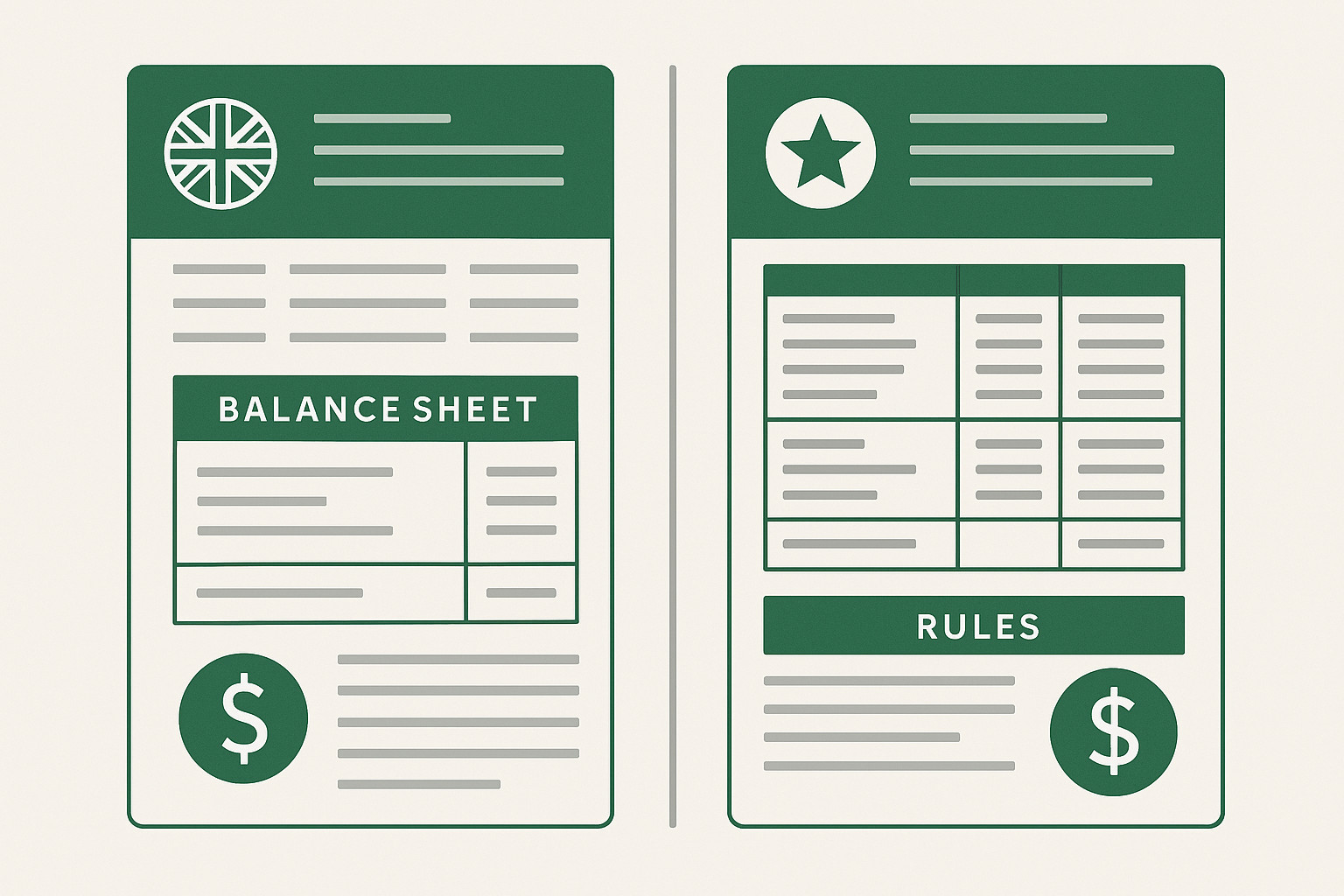
Accounting standards exist to ensure financial statements are consistent, transparent, and comparable. Two of the most widely referenced frameworks are UK GAAP and US GAAP. While both aim to present a true and fair view of a company’s financial performance and position, they differ significantly in structure, detail, and application.
Understanding these differences is especially important for multinational groups, investors, finance professionals, and companies planning cross-border expansion. This article provides a detailed comparison of UK GAAP and US GAAP, covering their foundations, key differences, and practical implications.
What Is UK GAAP?
UK GAAP (United Kingdom Generally Accepted Accounting Practice) refers to the accounting standards used by entities in the UK. Modern UK GAAP is primarily based on:
- FRS 102 – The Financial Reporting Standard applicable in the UK and Republic of Ireland
- FRS 105 – For micro-entities
- FRS 101 – Reduced disclosure framework for qualifying entities
UK GAAP is heavily aligned with IFRS (International Financial Reporting Standards), but it is simplified and adapted for UK-specific legal and reporting requirements.
Who Uses UK GAAP?
- Small and medium-sized entities (SMEs)
- UK subsidiaries of international groups
- Companies not required or not choosing to apply IFRS
What Is US GAAP?

US GAAP (United States Generally Accepted Accounting Principles) is the accounting framework used in the United States. It is developed and maintained by the Financial Accounting Standards Board (FASB).
US GAAP is known for its:
- Extensive detailed guidance
- Industry-specific rules
- Emphasis on consistency and comparability
Who Uses US GAAP?
- All publicly listed companies in the US
- Many private companies operating in the US
- International companies listed on US stock exchanges
Key Differences Between UK GAAP and US GAAP

1. Conceptual Approach
- UK GAAP
More principles-based, allowing professional judgment to determine the most appropriate accounting treatment. - US GAAP
More rules-based, with detailed guidance designed to cover many specific scenarios.
Impact:
UK GAAP offers flexibility, while US GAAP reduces interpretation risk but increases complexity.
2. Financial Statement Presentation
| Area | UK GAAP | US GAAP |
|---|---|---|
| Statement of financial position | Flexible layout | Prescriptive formats |
| Statement of cash flows | Required (some small entities exempt) | Mandatory for all |
| Terminology | Aligned with IFRS | US-specific terminology |
3. Revenue Recognition
- UK GAAP (FRS 102)
Based on IFRS principles, focusing on the transfer of risks and rewards or performance obligations. - US GAAP
Uses ASC 606, a detailed five-step revenue recognition model.
Key difference:
US GAAP provides more explicit guidance for complex arrangements such as software, licensing, and bundled services.
4. Lease Accounting
- UK GAAP
Under FRS 102, leases are classified as either operating or finance leases (similar to older IAS 17). - US GAAP
Requires lessees to recognize most leases on the balance sheet, classifying them as operating or finance leases, but both create right-of-use assets and lease liabilities.
Impact:
US GAAP generally results in higher reported assets and liabilities.
5. Development Costs
- UK GAAP
Development costs must be capitalized when certain criteria are met. - US GAAP
Development costs are generally expensed as incurred, except for specific software development scenarios.
This can lead to significantly different profit figures between the two standards.
6. Inventory Valuation
- UK GAAP
Inventory is measured at the lower of cost and net realizable value. LIFO is not permitted. - US GAAP
Allows LIFO (Last In, First Out) as an inventory valuation method.
Impact:
Companies using LIFO under US GAAP may report lower profits during periods of inflation.
7. Revaluation of Assets
- UK GAAP
Permits revaluation of certain non-current assets such as property, plant, and equipment. - US GAAP
Generally prohibits revaluation, requiring assets to be carried at historical cost less depreciation.
8. Financial Instruments
- UK GAAP
Uses a simplified model for recognition and measurement compared to full IFRS. - US GAAP
Has complex classification, measurement, and impairment rules with extensive disclosure requirements.
9. Consolidation and Group Accounts
- UK GAAP
Control-based model similar to IFRS, with some exemptions for small groups. - US GAAP
More detailed consolidation guidance, including variable interest entity (VIE) rules.
10. Disclosure Requirements
- UK GAAP
Generally fewer disclosures, especially for SMEs. - US GAAP
Extensive disclosure requirements, often resulting in longer financial statements.
Practical Implications for Businesses
For UK Companies Expanding to the US
- May need to maintain dual reporting (UK GAAP and US GAAP)
- Increased compliance costs
- Adjustments required for revenue, leases, and development costs
For Investors
- Financial results may not be directly comparable
- Understanding accounting differences is essential for proper valuation
For Group Reporting
- Differences can create consolidation challenges
- Reconciliation adjustments are often required at group level
UK GAAP vs US GAAP: Summary Table
| Area | UK GAAP | US GAAP |
|---|---|---|
| Approach | Principles-based | Rules-based |
| Complexity | Moderate | High |
| Flexibility | Higher | Lower |
| Disclosure burden | Lower | Higher |
| Global alignment | IFRS-aligned | US-specific |
Conclusion
UK GAAP and US GAAP serve the same fundamental purpose but differ significantly in execution. UK GAAP prioritizes flexibility and simplicity, making it suitable for SMEs and UK-focused entities. US GAAP emphasizes detailed guidance and consistency, which benefits large and complex organizations but increases reporting complexity.
For companies operating internationally, understanding these differences is not just an accounting exercise—it directly impacts financial performance, compliance, and strategic decision-making.