Tag: accounting basics

  • Double-Entry Bookkeeping Explained: How Journal Entries Keep Your Accounts in Balance

    Double-Entry Bookkeeping Explained: How Journal Entries Keep Your Accounts in Balance

    Every number in every set of accounts — whether for a sole trader, a growing SME, or a listed corporation — was put there by a journal entry. Double-entry bookkeeping is the language accountants use to record financial events, and it has been in continuous use since the Italian merchants of the fifteenth century first formalised it. Understanding how it works does not require a degree in accounting. What it requires is grasping one simple idea: every transaction affects two accounts, always, and the two effects must balance. Get comfortable with that principle, and the entire structure of accounting becomes logical rather than mysterious.

    What Is Double-Entry Bookkeeping?

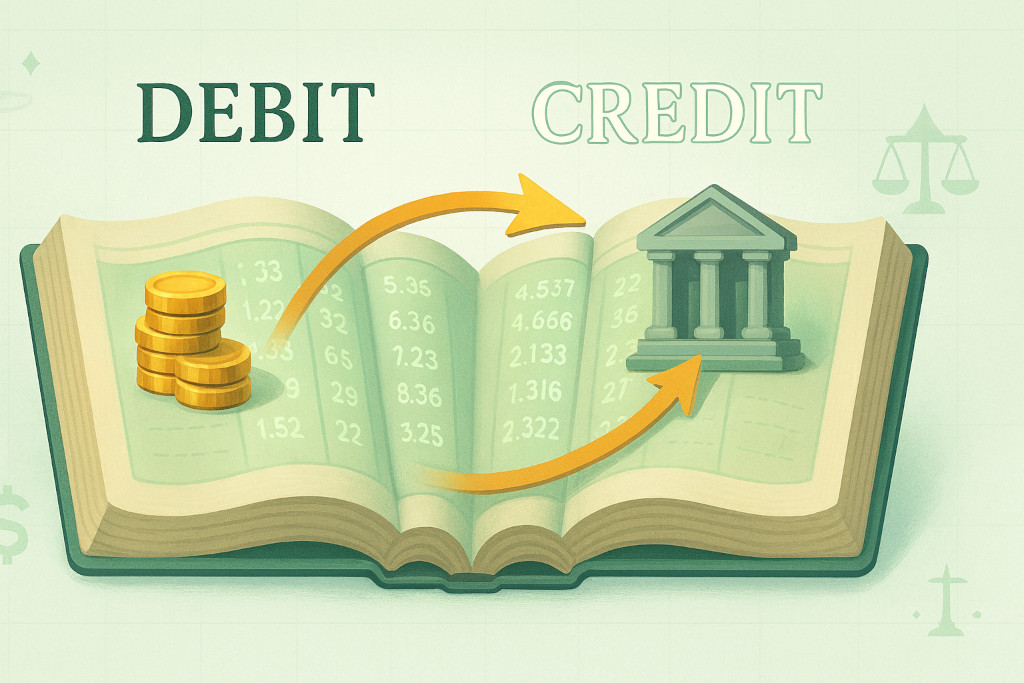
    Double-entry bookkeeping is a system in which every financial transaction is recorded as two equal and opposite entries — one debit and one credit — in different ledger accounts. The name comes from the fact that each transaction is entered twice: once on the debit side of one account, and once on the credit side of another.

    This is not an arbitrary accounting convention. It reflects economic reality. When a business buys a van for cash, two things happen simultaneously: the business gains an asset (the van) and loses an asset (the cash). Recording both sides of this exchange is what makes the books balance. If you only recorded the van arriving but not the cash leaving, your accounts would be out of balance — and the discrepancy would be the first sign something was wrong.

    The result of this system is that the total of all debits always equals the total of all credits. This self-balancing property is one of accounting’s most powerful error-detection mechanisms. When a trial balance — the summary of all account balances — does not balance, it signals immediately that an error has been made somewhere in the entries.

    Debits and Credits: The Golden Rules

    The single most common source of confusion in bookkeeping is the meaning of “debit” and “credit”. In everyday language, a debit means money going out of your bank account; a credit means money coming in. In double-entry bookkeeping, the words mean something more specific and often counterintuitive to beginners.

    In accounting, every ledger account belongs to one of five categories: assets, liabilities, equity, income, or expenses. The rule for debits and credits is different depending on the category:

    Account TypeA Debit…A Credit…Example Account
    AssetIncreases the balanceDecreases the balanceCash, Trade Debtors, Vehicles
    LiabilityDecreases the balanceIncreases the balanceBank Loan, Trade Creditors, VAT Payable
    EquityDecreases the balanceIncreases the balanceShare Capital, Retained Earnings
    Income / RevenueDecreases the balanceIncreases the balanceSales Revenue, Interest Received
    ExpenseIncreases the balanceDecreases the balanceWages, Rent, Depreciation

    A useful memory aid is DEAD CLICDebits increase Expenses, Assets, and Drawings; Credits increase Liabilities, Income, and Capital. Once this table is memorised, any transaction can be broken down logically into its two sides without guesswork.

    Debits and credits are not value judgements — “debit” does not mean “bad” and “credit” does not mean “good”. They are simply the left and right sides of every ledger account. Their effect — whether they increase or decrease a balance — depends entirely on the type of account they are applied to.

    Journal Entries in Practice: A Worked Example

    Birchwood Consultants Ltd is a small consultancy. In October, the following transactions occur. Let us record each as a double-entry journal entry.

    Transaction 1: Owner invests £20,000 into the business

    AccountDebit (£)Credit (£)Reason
    Bank (Asset)20,000Cash received — asset increases
    Share Capital (Equity)20,000Owner’s investment — equity increases

    Transaction 2: Business pays £1,200 for office rent

    AccountDebit (£)Credit (£)Reason
    Rent Expense (Expense)1,200Cost incurred — expense increases
    Bank (Asset)1,200Cash paid out — asset decreases

    Transaction 3: Business invoices a client £5,000 for consulting work

    AccountDebit (£)Credit (£)Reason
    Trade Debtors (Asset)5,000Amount owed to us — asset increases
    Consulting Revenue (Income)5,000Revenue earned — income increases

    Transaction 4: Client pays the £5,000 invoice

    AccountDebit (£)Credit (£)Reason
    Bank (Asset)5,000Cash received — asset increases
    Trade Debtors (Asset)5,000Debt cleared — asset decreases

    After all four transactions, the total of all debit entries (£31,200) equals the total of all credit entries (£31,200). The books balance. This is double-entry working as intended.

    From Journal Entries to Financial Statements

    Journal entries do not live in isolation. They flow through a structured sequence that ultimately produces the financial statements every business relies on.

    Each journal entry is first recorded in a journal (the book of original entry) in chronological order. The entries are then posted to individual ledger accounts — one account per category, such as “Bank”, “Rent Expense”, or “Trade Debtors”. Each ledger account is typically visualised as a T-account, with debits on the left and credits on the right, allowing the running balance to be tracked at a glance.

    Periodically — usually at month-end — all ledger account balances are extracted into a trial balance. If the total of all debit balances equals the total of all credit balances, the bookkeeping is arithmetically correct. The trial balance then feeds directly into the preparation of the three core financial statements: the income statement (profit and loss), the balance sheet, and the cash flow statement.

    This chain — from individual transaction to financial statement — is the same whether you are using a paper ledger, a spreadsheet, or modern accounting software like Xero or QuickBooks. The software automates the posting and trial balance, but every entry it makes follows the same double-entry logic. For businesses that operate across multiple entities, the same principle applies at the consolidation stage: group accountants must understand the underlying journal entries in each subsidiary in order to correctly eliminate intercompany transactions and produce accurate group accounts. BrizoConsol’s guide on delivering consolidated financials without the manual work explains how this aggregation process works in practice for multi-entity groups.

    Common Journal Entry Types for SMEs

    While every transaction is unique, most SME bookkeeping involves a relatively small set of recurring entry types. Becoming fluent with these covers the vast majority of day-to-day accounting:

    • Sales invoice raised: Debit Trade Debtors / Credit Sales Revenue
    • Customer payment received: Debit Bank / Credit Trade Debtors
    • Purchase invoice received: Debit Expense or Asset / Credit Trade Creditors
    • Supplier payment made: Debit Trade Creditors / Credit Bank
    • Wages paid: Debit Wages Expense / Credit Bank
    • Depreciation charged: Debit Depreciation Expense / Credit Accumulated Depreciation
    • Prepayment (e.g. insurance paid in advance): Debit Prepayment Asset / Credit Bank; then reverse monthly as expense accrues
    • Accrual (e.g. electricity bill not yet received): Debit Electricity Expense / Credit Accruals (Liability)
    • Loan received: Debit Bank / Credit Loan Liability
    • Dividend paid: Debit Retained Earnings / Credit Bank

    The accruals and prepayments entries in particular are central to the accruals basis of accounting — the principle that income and expenses are recognised when they are earned or incurred, not simply when cash changes hands. This is what separates proper financial accounting from simple cashbook recording, and it is what makes financial statements meaningful for decision-making rather than merely a record of bank movements.


    Key Takeaways

    • Double-entry bookkeeping records every transaction as two equal and opposite entries — a debit in one account and a credit in another.
    • Debits increase assets and expenses; credits increase liabilities, equity, and income. The mnemonic DEAD CLIC helps: Debits increase Expenses, Assets, Drawings; Credits increase Liabilities, Income, Capital.
    • The system is self-balancing: total debits always equal total credits. A trial balance that does not balance signals a bookkeeping error.
    • Journal entries flow through ledger accounts and a trial balance before becoming the income statement, balance sheet, and cash flow statement.
    • Most day-to-day SME bookkeeping involves ten or so recurring entry types. Mastering these covers the overwhelming majority of transactions a business will encounter.
    • Accounting software automates the posting and trial balance, but the underlying double-entry logic is identical — understanding it makes you a more confident and critical user of any accounting system.

    Related reading: Double-entry bookkeeping is the mechanism that keeps the Accounting Equation (Assets = Liabilities + Equity) permanently in balance. The ledger accounts for assets and liabilities flow directly into the Balance Sheet, while income and expense accounts form the Income Statement. For a broader introduction to the discipline that connects all of these concepts, see our post on Accounting Made Simple.

  • Depreciation Methods Explained: Straight-Line, Reducing Balance and Beyond

    Depreciation Methods Explained: Straight-Line, Reducing Balance and Beyond

    Every piece of equipment, vehicle, and machine your business owns was worth more the day you bought it than it is today. This steady loss of value is not a flaw in your accounting — it is a fundamental principle called depreciation, and how you account for it directly affects your profit figure, your tax position, and the accuracy of your balance sheet. For SME owners and accountants alike, understanding the main depreciation methods — and knowing which one to apply — is one of the most practically useful skills in the accounting toolkit.

    What Is Depreciation and Why Does It Matter?

    When a business buys a long-term asset — a delivery van, a piece of machinery, a computer server — it does not expense the full cost in the year of purchase. Instead, it spreads that cost over the asset’s useful working life. This spreading of cost is depreciation.

    There are two core reasons this matters. First, it gives a truer picture of profitability. If you expensed a £40,000 van in full the year you bought it, your profit that year would appear artificially low. By depreciating it over five years at £8,000 per year, each year’s accounts reflect the actual consumption of that asset’s value. Second, the accumulated depreciation reduces the carrying value of the asset on your balance sheet — keeping it aligned with economic reality rather than overstating what the business actually owns.

    Depreciation is a non-cash expense. It reduces profit and therefore reduces the tax liability, but no cash leaves the business at the point the depreciation charge is recorded. Cash only left when the asset was originally purchased.

    The Main Methods of Depreciation

    There are three methods you will encounter most frequently in practice. Each produces a different pattern of annual charges, and each suits different types of asset.

    1. Straight-Line Depreciation

    The simplest and most widely used method. The asset loses the same fixed amount of value each year over its useful life.

    Formula: Annual Depreciation = (Cost − Residual Value) ÷ Useful Life (years)

    The residual value (sometimes called scrap value) is the estimated amount the asset will be worth at the end of its useful life. If an asset will be worthless at disposal, residual value is zero.

    2. Reducing Balance Depreciation

    Also called the declining balance method. The depreciation charge is calculated as a fixed percentage of the asset’s remaining book value each year — not its original cost. This means the charge is higher in early years and tapers off over time, which better reflects how many assets (especially technology and vehicles) lose value more quickly when new.

    Formula: Annual Depreciation = Net Book Value at Start of Year × Depreciation Rate %

    3. Units of Production (Activity-Based) Depreciation

    Rather than spreading cost over time, this method ties depreciation to actual usage. It is best suited to assets whose wear is genuinely driven by how much they are used — a printing press, a quarry vehicle, or specialised manufacturing equipment.

    Formula: Depreciation per Unit = (Cost − Residual Value) ÷ Estimated Total Units of Production
    Annual Charge = Depreciation per Unit × Units Produced in the Year

    Worked Example: Comparing the Three Methods

    Ashford Printing Ltd purchases a digital press for £50,000. It has an estimated useful life of five years and a residual value of £5,000. In a typical year the press handles approximately 200,000 print runs; total estimated lifetime output is 1,000,000 print runs. The table below shows Year 1 and Year 3 charges under each method.

    MethodYear 1 Charge (£)Year 2 Charge (£)Year 3 Charge (£)Year 4 Charge (£)Year 5 Charge (£)Total (£)
    Straight-Line (20%)9,0009,0009,0009,0009,00045,000
    Reducing Balance (30%)15,00010,5007,3505,1453,60241,597*
    Units of Production (200k/yr)9,0009,0009,0009,0009,00045,000

    *Reducing balance at 30% leaves a residual book value of approximately £8,403 after five years. The rate would typically be set to bring the asset to its expected residual value — the figures above illustrate the pattern rather than an exact match.

    Notice how the reducing balance method front-loads the expense: Ashford records a £15,000 charge in Year 1 versus £9,000 under straight-line. By Year 3, the reducing balance charge (£7,350) has dropped below the straight-line equivalent. This can have meaningful effects on reported profit — and therefore tax — in the early years of an asset’s life.

    The depreciation method you choose does not change the total cost of the asset over its life — only the timing of when that cost hits your profit and loss account. Consistency and transparency in your chosen approach matter more than which method you pick.

    Choosing the Right Method for Your Asset

    No single method suits every asset. The key question is: how does this asset actually lose its value?

    Use straight-line when the asset provides roughly equal benefit each year — office furniture, leasehold improvements, most computer equipment, and commercial property fixtures are good candidates. It is predictable, easy to explain to stakeholders, and administratively simple.

    Use reducing balance for assets that decline in value rapidly when new — vehicles are the classic example. A van bought for £25,000 might lose £8,000 of market value in its first year, but only £3,000 in its fourth year. The reducing balance method aligns the accounting charge with this economic reality, producing a smoother match between the asset’s book value and its market value.

    Use units of production for assets where utilisation, not time, is the primary driver of wear — heavy plant, specialist manufacturing tools, or mining equipment. If the machine sits idle for six months, no depreciation charge is recorded, which is a more accurate reflection of what happened economically.

    Once chosen, the method should be applied consistently across similar asset classes and disclosed in the accounting policies note of your financial statements. Changing method without good reason raises questions with auditors and HMRC alike.

    Depreciation, Residual Value, and Useful Life: The Key Estimates

    Depreciation calculations rest on two estimates that require professional judgement: useful life and residual value. Both should reflect the business’s genuine expectations, not a default figure.

    Useful life varies significantly by asset type. HMRC’s capital allowance rules provide a tax-focused view, but accounting depreciation and tax depreciation are separate concepts — a business may depreciate an asset over seven years for accounting purposes while claiming capital allowances under a different rate for tax. The difference creates timing differences that, in some cases, give rise to a deferred tax liability. (Our post on deferred tax covers this in detail.)

    Residual value should be reviewed periodically. If market conditions change — for example, a particular model of vehicle loses value more rapidly than expected due to changing emissions regulations — the residual value estimate should be revised, and the remaining depreciation recalculated over the remaining useful life.

    Depreciation treatment also varies depending on which accounting standards a business follows. Under IFRS (IAS 16), businesses have the option to revalue certain fixed assets to fair value and then depreciate from the revalued amount — a treatment not available under UK GAAP’s FRS 102. BrizoConsol’s comparison of IFRS vs UK GAAP key differences in financial reporting is a useful reference if your business is considering which framework applies, particularly for groups with international subsidiaries.

    Common Depreciation Mistakes to Avoid

    • Applying a single method to all assets indiscriminately. A laptop and a quarrying truck have very different usage profiles. Using straight-line for everything is administratively convenient but may misrepresent the economics.
    • Setting residual value to zero by default. Many assets retain meaningful value at end of use — vehicles, specialist tools, and plant equipment are often sold secondhand. Ignoring residual value overstates the annual depreciation charge.
    • Forgetting to start depreciation in the month of acquisition. Some businesses depreciate a full year’s charge regardless of when an asset was bought. A pro-rata charge from the acquisition date is more accurate (and required under some standards).
    • Continuing to depreciate fully depreciated assets. Once an asset reaches its residual value, depreciation stops. A nil net book value asset that is still in use should be disclosed as such — not written down further.
    • Confusing accounting depreciation with tax depreciation (capital allowances). These are separate calculations. The accounting charge goes through your P&L; the capital allowance claim goes on your tax return. They rarely match in any given year.

    Key Takeaways

    • Depreciation spreads the cost of a long-term asset over its useful life, matching the expense to the periods that benefit from the asset’s use.
    • The three main methods are straight-line (equal annual charge), reducing balance (front-loaded charge), and units of production (usage-based charge).
    • Method choice should reflect how the asset actually loses value — not simply default to the simplest option.
    • Two key estimates drive depreciation: useful life and residual value. Both require regular review.
    • Accounting depreciation and tax capital allowances are separate calculations — differences between them can create deferred tax positions.
    • Once chosen, apply your depreciation policies consistently and disclose them clearly in your financial statements.

    Related reading: Depreciation appears as a line on your Income Statement and reduces the carrying value of assets on your Balance Sheet. When the timing difference between accounting depreciation and tax allowances creates a deferred tax balance, our guide to Deferred Tax Liability explains what that means and how it is recorded. For a broader overview of the financial frameworks your business may operate under, see our guide to IFRS.