Tag: financial reporting

  • Management Accounts vs Statutory Accounts: What’s the Difference and Why It Matters

    Management Accounts vs Statutory Accounts: What’s the Difference and Why It Matters

    Ask most SME owners whether they have accounts and the answer is yes. Ask them which type, and the answer often becomes less certain. There are actually two very different kinds of financial accounts that a business produces — statutory accounts and management accounts — and they serve entirely different purposes, for entirely different audiences, at entirely different times of year. Confusing the two, or worse, relying only on one when you need both, can leave a business flying blind on the inside or out of step with its legal obligations on the outside. Understanding the distinction is simpler than it sounds, and getting it right makes you a significantly more effective manager of your own business.

    What Are Statutory Accounts?

    Statutory accounts — sometimes called annual accounts or financial statements — are the formal set of financial reports that a limited company is legally required to prepare at the end of each financial year. In the UK, these must be filed with Companies House and submitted to HMRC alongside the company’s corporation tax return. Missing the deadline attracts automatic penalties; persistent late filing can ultimately lead to the company being struck off.

    Statutory accounts must comply with a specific accounting framework — either UK GAAP (typically FRS 102 or FRS 105 for micro-entities) or IFRS for larger or listed businesses. They follow a prescribed format and must include, as a minimum, a profit and loss account and a balance sheet. Larger companies must also include a cash flow statement, directors’ report, and auditor’s report.

    The primary audience for statutory accounts is external: Companies House (where they become publicly accessible), HMRC, lenders, investors, and potential business partners who want an independent, standardised view of the company’s financial position. Because they are public and compliance-driven, statutory accounts tend to be prepared conservatively, with significant attention to legal disclosure requirements. They are typically signed off by the directors and, above a certain size threshold, audited by an independent firm.

    The key thing to understand about statutory accounts is that they look backwards. They tell you what happened in the financial year that has just ended — often six to nine months after the events they describe, by the time they have been prepared, reviewed, and filed. They are an accountability document, not a management tool.

    What Are Management Accounts?

    Management accounts are internal financial reports prepared specifically to help the people running the business make better decisions. There is no legal requirement to produce them, no prescribed format, and no filing obligation. They exist entirely to serve the management team.

    Unlike statutory accounts, management accounts are produced regularly — typically monthly or quarterly — and are available quickly after the period they cover, often within one to two weeks of month-end. Their purpose is to show what is happening in the business right now, so that problems can be identified and addressed before they become serious, and opportunities can be acted on while they are still relevant.

    Because management accounts are internal and flexible, they can be shaped around what matters most to that particular business. A manufacturing company might focus heavily on production costs and stock levels. A professional services firm might track utilisation rates and work-in-progress. A retail business might lead with revenue by product line and gross margin by category. The format follows the business, not a regulatory template.

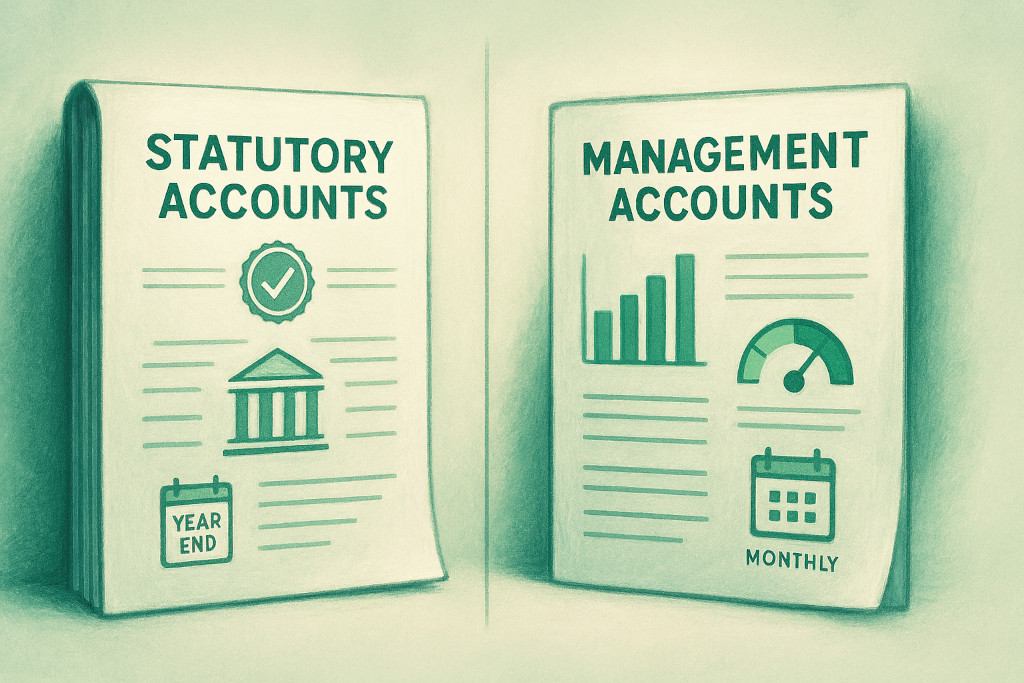
    Statutory accounts tell you how the year ended. Management accounts tell you how the month is going. Both matter — but only one of them can actually steer the ship.

    Key Differences at a Glance

    FeatureStatutory AccountsManagement Accounts
    Legal requirement?Yes — required by law for limited companiesNo — produced by choice
    Primary audienceCompanies House, HMRC, investors, lendersDirectors, management team, internal stakeholders
    FrequencyAnnual (once per financial year)Monthly or quarterly
    TimingMonths after year-end (filing deadline: 9 months for private companies)Days to weeks after the reporting period
    FormatPrescribed by accounting standards (UK GAAP / IFRS)Flexible — tailored to the business
    Level of detailSummarised; prescribed disclosure notesCan be highly granular — departmental, product-level, regional
    Includes KPIs?Rarely — only in strategic or directors’ reports for larger companiesYes — KPIs, trends, variance analysis, commentary
    PurposeCompliance, accountability, external credibilityDecision-making, performance monitoring, forecasting
    Prepared byAccountant, often with external review or auditFinance team or management accountant
    Publicly available?Yes (filed at Companies House)No — strictly internal

    What Should Management Accounts Include?

    There is no single correct format, but a well-constructed management accounts pack for an SME will typically contain the following elements:

    • Profit and Loss Account (vs budget and prior year). The core statement showing revenue, gross profit, operating costs, and net profit for the month and year-to-date. Critically, it should be shown alongside the budget and the same period last year, so performance can be contextualised rather than viewed in isolation.
    • Balance Sheet. A snapshot of assets, liabilities, and equity at the month-end date. Tracking the balance sheet monthly surfaces changes in debtor balances, creditor levels, and cash position that the P&L alone would miss.
    • Cash Flow Statement or Cash Position Summary. Cash is not the same as profit, and a monthly cash summary — actual receipts and payments versus forecast — is often the most urgently read page in the pack. For more on why this matters, see our guide to the Cash Flow Statement.
    • Variance Analysis. A clear explanation of where actual performance differed from budget, with commentary on whether variances are timing differences, one-off items, or signals of a structural change in the business.
    • Key Performance Indicators (KPIs). Four to eight metrics that are specific to this business and its strategy — revenue per head, gross margin %, debtor days, utilisation rate, or whatever drives performance in this particular industry.
    • Forward-looking commentary. A short narrative from the finance director or management accountant covering the outlook for the coming month or quarter. This is what separates a genuinely useful management pack from a collection of historical tables.

    Who Needs Management Accounts — and When?

    Very small businesses — sole traders, micro-companies with one or two employees — may find that their bookkeeping software gives them enough real-time visibility that a formal monthly management accounts pack is unnecessary. But as a business grows beyond a handful of people, the case for regular management accounts becomes compelling and eventually unavoidable.

    Banks and investors increasingly expect to see management accounts when a business applies for finance, requests a credit facility, or seeks investment. A set of accounts from nine months ago tells a lender very little about the current state of the business. Monthly or quarterly management accounts — professionally produced, with commentary — demonstrate financial maturity and give any external party the confidence to engage seriously.

    For businesses operating across multiple entities or subsidiaries, the challenge extends further: management accounts need to reflect the consolidated group picture, not just individual entity results. At this level, the manual effort of aggregating financials across entities becomes significant. Tools designed for multi-entity reporting — such as those described in BrizoConsol’s guide on delivering consolidated financials without the manual work — can substantially reduce the time from month-end close to a complete management pack.

    Do Statutory Accounts and Management Accounts Always Agree?

    Not always, and this surprises some business owners when they first notice it. There are several legitimate reasons the two may differ:

    • Timing adjustments. Statutory accounts include year-end adjustments — accruals, prepayments, stock counts, depreciation — that may not have been applied to every month’s management accounts during the year.
    • Tax adjustments. The statutory P&L is adjusted for deferred tax, which does not typically appear in monthly management accounts.
    • Audit adjustments. If the statutory accounts are audited, the auditor may require adjustments that were not in the management accounts.
    • Different accounting policies. In some cases, management accounts use simplified policies (for speed) while statutory accounts apply the full rigour of the relevant accounting standard.

    A material unexplained difference between the two is a quality control concern. Good practice is to reconcile the year-to-date management accounts to the draft statutory accounts during the year-end process, identifying and documenting the reasons for any gaps.


    Key Takeaways

    • Statutory accounts are a legal requirement for limited companies — annual, compliance-driven, filed publicly, and prepared to a prescribed accounting standard.
    • Management accounts are voluntary, internal, and produced regularly (typically monthly) to help the business make better decisions faster.
    • Statutory accounts look backwards at the year just ended. Management accounts look at what is happening now and what is coming next.
    • A good management pack includes a P&L (vs budget and prior year), balance sheet, cash position, variance commentary, KPIs, and a forward-looking narrative.
    • Lenders and investors increasingly expect current management accounts — not just last year’s statutory filing — before making financing decisions.
    • Differences between management and statutory figures are normal; material unexplained gaps are not. Reconcile the two at year-end.

    Related reading: The statements that form the core of both management and statutory accounts are covered in detail elsewhere on this site — the Income Statement, the Balance Sheet, and the Cash Flow Statement. For the accounting standards that govern how statutory accounts must be presented, see our guide to IFRS and our comparison of UK GAAP and US GAAP.