

Every year, thousands of SME owners pay more corporation tax than they need to — not because they are careless, but because nobody has explained how capital allowances actually work. You buy a piece of machinery, a van, or new computer equipment, and it sits on your balance sheet quietly depreciating over several years. Meanwhile, your accountant mentions something called ‘AIA’ on your tax computation and moves on. If you do not understand what that means, you cannot plan your purchases around it, and you may be leaving thousands of pounds of tax relief unclaimed or claimed in the wrong year. This article explains, in plain English, how the Annual Investment Allowance works and how it can bring your corporation tax bill down significantly the moment you invest in your business.
What Is the Annual Investment Allowance?
When your business buys equipment — machinery, tools, office furniture, computers, vans — the cost does not usually reduce your profit straight away in your accounts. Instead, it is spread out over several years through depreciation. But HMRC does not let you deduct depreciation from your taxable profit at all. Instead, it uses a separate system called capital allowances, and one of the most generous of these is the Annual Investment Allowance, or AIA. The AIA lets you deduct the full cost of most qualifying equipment from your taxable profit in the same year you buy it, rather than spreading the relief over many years. The AIA limit is permanently set at £1,000,000 per 12-month accounting period rather than being a temporary boost. In practice, this means that for the vast majority of SMEs, every pound spent on qualifying equipment in a given year reduces taxable profit pound for pound, up to that £1,000,000 ceiling.
How AIA Reduces Your Corporation Tax Bill
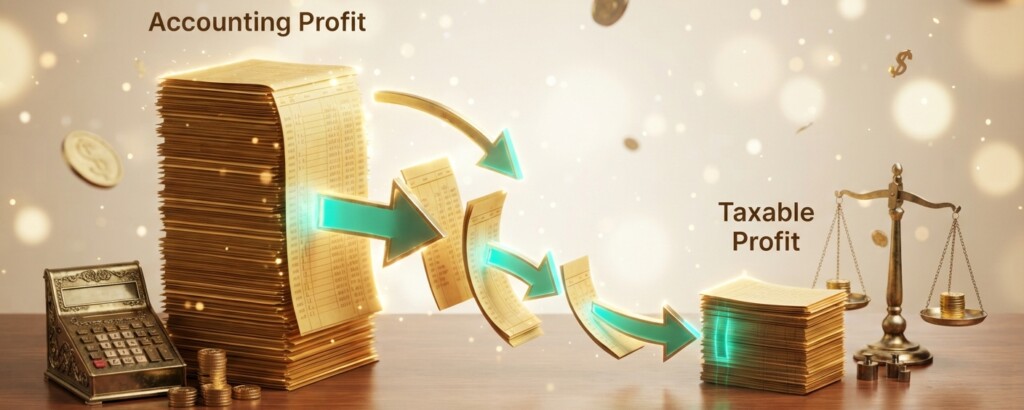
Your corporation tax bill is calculated on taxable profit, not on the profit shown in your accounts. To get from accounting profit to taxable profit, your accountant adds back depreciation (because it is not tax-deductible) and then deducts capital allowances instead. When you claim AIA on a qualifying purchase, that deduction can be large enough to wipe out most or all of the taxable profit generated by the investment itself in that year. The effect is that your tax bill falls in the same year you spend the money, rather than trickling down slowly over the useful life of the asset. This matters for cash flow: a big purchase and a big tax saving can land in the same accounting period, softening the impact on your bank balance.
| Profit before capital allowances | £300,000 |
| Less: Annual Investment Allowance claim | -£80,000 |
| Taxable profit after AIA | £220,000 |
| Corporation tax due at 25% (main rate) | £55,000 |
Worked Example: Buying New Machinery for Your Workshop
Imagine a manufacturing SME with a profit before capital allowances of £300,000 for the year. In March, before the year-end, the owner buys a new piece of production machinery for £80,000, paid in full from the company bank account. Because this machinery qualifies for AIA and the company is well within the £1,000,000 annual limit, the full £80,000 can be deducted from taxable profit in that same accounting period. The table below shows the difference this makes compared with a scenario where no AIA claim is made — for example, if the equipment did not qualify or the allowance had already been used up elsewhere in a group, assuming the 25% main rate applies.
| Without AIA claim | With AIA claim | |
|---|---|---|
| Profit before capital allowances | £300,000 | £300,000 |
| Capital allowances claimed | £0 | £80,000 |
| Taxable profit | £300,000 | £220,000 |
| Corporation tax at 25% | £75,000 | £55,000 |
| Tax saved by claiming AIA | — | £20,000 |
That £20,000 difference is real cash that stays in the business rather than going to HMRC (and for a standalone company where profits between £50,000 and £250,000 fall into marginal relief, the effective saving can be even higher at up to 26.5%). It is important to understand that this saving comes through the corporation tax computation, not through a separate entry in your bookkeeping records. Your accounts still show the machinery as a fixed asset and depreciate it over its useful life in the normal way. The AIA claim is a tax adjustment made when preparing the corporation tax return, sitting alongside — not instead of — your standard accounting treatment.
| Account | Dr | Cr |
|---|---|---|
| Plant and Machinery (Fixed Assets) | £80,000 | |
| Bank | £80,000 |
Recording the purchase of new production machinery, paid in full from the company bank account. This entry reflects the accounting treatment; the asset will be depreciated over its useful economic life in the accounts.
| Account | Dr | Cr |
|---|---|---|
| Corporation Tax Expense (P&L) | £55,000 | |
| Corporation Tax Payable (Balance Sheet) | £55,000 |
Provision for corporation tax based on taxable profit of £220,000 at the 25% main rate, after deducting the £80,000 Annual Investment Allowance claim from profit before capital allowances of £300,000.
The Annual Investment Allowance limit is permanently set at £1,000,000 per 12-month accounting period. It covers most plant and machinery, but must be actively claimed on your corporation tax return — it is not applied automatically by your accounting software or bookkeeping records.

What Does Not Qualify for AIA
AIA is generous, but it does not cover everything. Cars are specifically excluded from AIA, regardless of how the vehicle is used in the business — these instead attract writing down allowances based on the car’s CO2 emissions (or a 100% first-year allowance for new zero-emission cars). Land, buildings, and structural elements of a property are excluded too, although qualifying integral features and fixtures within commercial premises do qualify. Plant and machinery acquired for use in a let dwelling-house also cannot qualify. Furthermore, plant and machinery acquired from a connected party — such as a director selling personal equipment into the company — or assets previously owned for non-business purposes are entirely barred from AIA. Unlike full expensing, however, qualifying plant and machinery bought for commercial leasing generally remains eligible for AIA. If you are planning a significant purchase and are unsure whether it qualifies, it is worth checking with your accountant before committing, rather than assuming the relief will apply.
AIA is given for the accounting period in which the expenditure is incurred — which for tax purposes is when the obligation to pay becomes unconditional (usually upon delivery of the asset, rather than simply signing an order) — not necessarily when cash leaves the bank. Companies that are part of a group, or under common control with other companies, must also share a single £1,000,000 AIA limit between them, which can catch out owners running several small businesses who assume each company gets its own full allowance.
Takeaways You Can Apply Now
- Before making a large equipment purchase, check how much of your £1,000,000 AIA limit remains for the accounting period, especially if you run more than one company under common control.
- Time significant purchases around your accounting year-end deliberately — ensuring the unconditional obligation to pay (typically delivery) falls before the year-end so the tax relief lands in the desired period.
- Remember that cars do not qualify for AIA — if you are replacing company vehicles, discuss writing down allowances or first-year allowances with your accountant before assuming full relief.
- Treat AIA as a tax return adjustment, not a bookkeeping entry — your accounts will still show depreciation as normal, so do not expect your software to calculate the saving automatically.
Want help getting your capital allowances right?
Understanding capital allowances is one of the simplest ways to reduce your corporation tax bill, but getting the timing and eligibility right takes care. We help SME owners and finance teams turn tax rules like this into clear, practical decisions for their business.
