For most owner-managers of limited companies, dividends are the primary way they extract profit from their business — and for good reason. Dividends are taxed more favourably than salary, they do not attract National Insurance contributions, and they give shareholders flexibility over the timing and amount of their income. But dividends come with rules that are often misunderstood: they can only be paid from distributable profit, they require proper documentation, and they must be recorded correctly in the company’s accounts. Getting these things wrong — paying dividends from a company with no retained profit, or failing to document the decision — can have serious legal and tax consequences. This guide explains how dividends work, when they can be paid, how to account for them, and what the tax implications are for shareholders.
What Is a Dividend?
A dividend is a distribution of a company’s after-tax profits to its shareholders, in proportion to their shareholding. Unlike a salary, a dividend is not a business expense — it is a distribution of profit that has already been subject to corporation tax. It appears in the company’s accounts as a reduction in retained earnings (on the balance sheet) and is not shown on the income statement.
In a small owner-managed limited company, the shareholder and the director are often the same person. They receive a salary for their work as director (which is a deductible business expense and processed through PAYE) and dividends as a return on their ownership of the company. The combination of salary and dividends is the standard tax-efficient remuneration structure for most owner-managers.
Dividends can only be paid to shareholders in proportion to their shares. If a company has two shareholders each holding 50% of the ordinary shares, a dividend must be paid in equal amounts to both — you cannot pay one shareholder and not the other without specific share structures (such as different classes of shares) that allow differentiated dividends.
When Can a Company Pay a Dividend?
This is the most commonly misunderstood aspect of dividend accounting. A company can only pay a dividend if it has sufficient distributable profits — that is, accumulated retained earnings after all taxes and prior losses. A company cannot legally pay a dividend out of its share capital, from a bank overdraft, or in anticipation of future profits it has not yet earned.
Distributable profits are found on the balance sheet as retained earnings (also called accumulated profit or profit and loss reserve). If the retained earnings figure is positive and sufficient to cover the proposed dividend, the payment is lawful. If retained earnings are negative — because the company has made cumulative losses — no dividend can legally be paid regardless of the company’s current cash position.
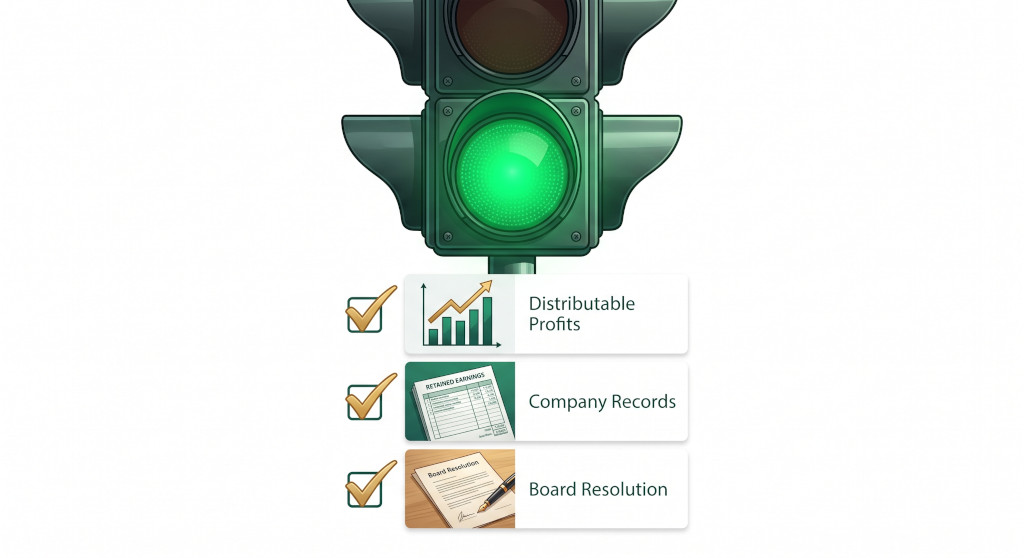
Three conditions must be satisfied before a dividend is paid:
- Sufficient distributable profit exists — check the latest management accounts or year-end accounts for the retained earnings figure.
- A formal decision is made — for a final dividend, this is a shareholder resolution; for an interim dividend, a board resolution is sufficient.
- Proper documentation is prepared — a dividend voucher must be issued to each shareholder at the time of payment.
Paying a dividend when the company does not have sufficient distributable profits is an unlawful distribution under the Companies Act. Directors who authorise such payments can be held personally liable to repay them. This is not a technicality — it is a fundamental legal constraint on how company profits are distributed.
How to Record a Dividend in Your Accounts
The accounting for a dividend is straightforward once you understand that it is a distribution of retained profit — not an expense — and therefore does not appear on the income statement.
The journal entries
When a dividend is declared and paid, two entries are needed:
At the point of declaration:
- Debit: Retained Earnings (equity — reduces the profit reserve)
- Credit: Dividends Payable (liability — the company owes this to shareholders)
At the point of payment:
- Debit: Dividends Payable (clears the liability)
- Credit: Bank (cash leaves the business)
In practice, for small companies where declaration and payment happen on the same day, these two entries are often combined into a single entry: Debit Retained Earnings / Credit Bank.
Worked Example
A limited company has two equal shareholders. The directors decide to pay an interim dividend of £20,000 in total (£10,000 to each shareholder) on 15 August 2026. The company’s retained earnings before the dividend are £85,000.
| Date | Account | Debit | Credit | Note |
|---|---|---|---|---|
| 15 Aug 2026 | Retained Earnings | £20,000 | — | Reduces equity reserve |
| 15 Aug 2026 | Bank | — | £20,000 | Cash paid to shareholders |
After the dividend, retained earnings fall from £85,000 to £65,000. The bank balance reduces by £20,000. The income statement is unaffected — corporation tax has already been accounted for on the profits from which this dividend is paid.
Dividend vouchers
At the time of every dividend payment, the company must issue a dividend voucher to each shareholder. This is a simple document that records:
- The company name and registered number
- The date of payment
- The shareholder’s name
- The amount of dividend paid
- The number and class of shares on which the dividend is paid
Shareholders need this document to complete their personal Self Assessment tax returns. Without it, they cannot correctly report their dividend income to HMRC.
Dividend Tax — What Shareholders Pay
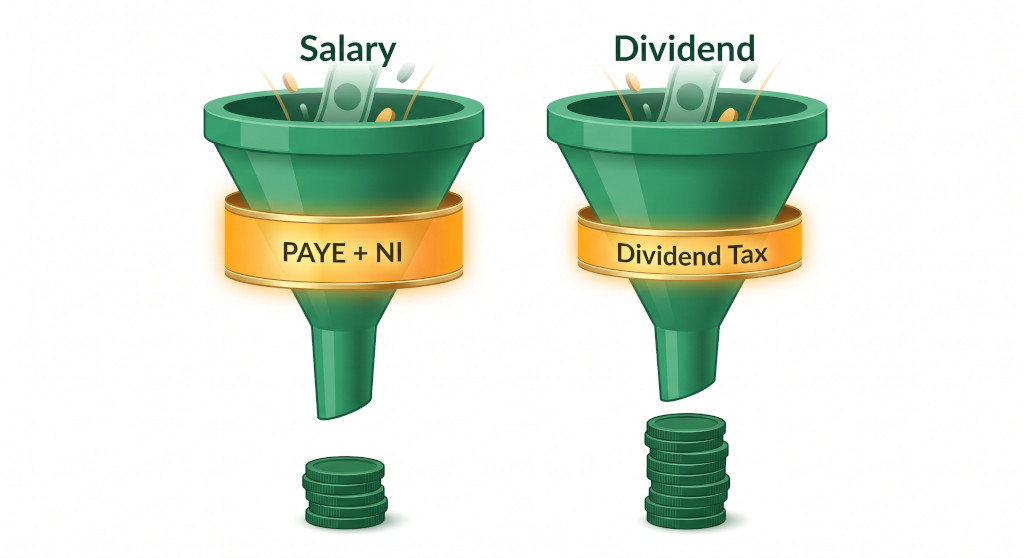
Dividends received by shareholders are subject to dividend tax on their personal tax return — not Income Tax at the standard rates. Dividend tax rates are lower than income tax rates, which is a key reason the salary-and-dividend combination is tax-efficient for owner-managers.
Each individual has an annual dividend allowance — an amount of dividend income that can be received tax-free each year (check HMRC’s current rates, as these change). Above the allowance, dividend income is taxed at the following rates (2026 — verify with HMRC for the current year):
| Tax Band | Dividend Tax Rate | Comparison: Income Tax Rate |
|---|---|---|
| Basic rate (up to ~£50,270) | 8.75% | 20% |
| Higher rate (~£50,271–£125,140) | 33.75% | 40% |
| Additional rate (above ~£125,140) | 39.35% | 45% |
Crucially, dividends are also not subject to National Insurance Contributions — neither the employee’s nor the employer’s element. For an owner-manager earning entirely through salary, NI adds a further 12–13.8% cost on top of income tax. This is the primary reason why owner-managers favour dividend income over additional salary above the NI threshold.
It is important to note that dividends are paid from profit that has already been subject to corporation tax. The effective combined tax rate (corporation tax on profit + dividend tax on distribution) is higher than the headline dividend tax rate alone — a point that is sometimes overlooked when comparing sole trader and limited company taxation.
Interim Dividends vs Final Dividends
There are two types of dividend a limited company can pay, and the governance requirements differ slightly between them.
Interim dividends are paid during the company’s financial year, before the final accounts are prepared. They are approved by a board resolution — the directors alone can authorise them, without a shareholder vote (unless the Articles of Association require otherwise). Most owner-managed companies pay interim dividends, because the year-end accounts may take months to finalise.
Final dividends are declared after the year-end accounts are prepared, based on the confirmed retained earnings. They technically require shareholder approval via an ordinary resolution at the Annual General Meeting (or written resolution), though in a one-person company the same individual is both director and shareholder.
For practical purposes in a small company, the most important distinction is documentation: interim dividends require a board minute; final dividends require a shareholder resolution. Both require a dividend voucher issued to each shareholder at the time of payment.
Understanding how dividends interact with your company’s equity and retained earnings is much easier once you are comfortable reading a balance sheet. The post on balance sheet structure and key elements explains where retained earnings sits and how equity movements flow through. And for a fuller picture of how company funding — including share capital and debt — relates to dividends, the guide to understanding funding in accounting covers the broader context.
Key Takeaways
- A dividend is a distribution of after-tax company profits to shareholders — it is not a business expense and does not appear on the income statement.
- Dividends can only be paid from distributable profits (positive retained earnings). Paying a dividend without sufficient distributable profit is an unlawful distribution under the Companies Act.
- The accounting entry is: Debit Retained Earnings / Credit Bank — reducing equity and cash simultaneously.
- A dividend voucher must be issued to each shareholder at the time of payment, recording the amount, date, and share class. Shareholders need this for their Self Assessment return.
- Dividend tax rates (8.75% / 33.75% / 39.35%) are lower than income tax rates, and dividends are not subject to National Insurance — making them the tax-efficient component of owner-manager remuneration.
- Interim dividends require a board resolution; final dividends require a shareholder resolution. Both require a dividend voucher.
- The effective tax burden on dividends includes corporation tax already paid on the underlying profit — the headline dividend tax rate is not the only tax in play.