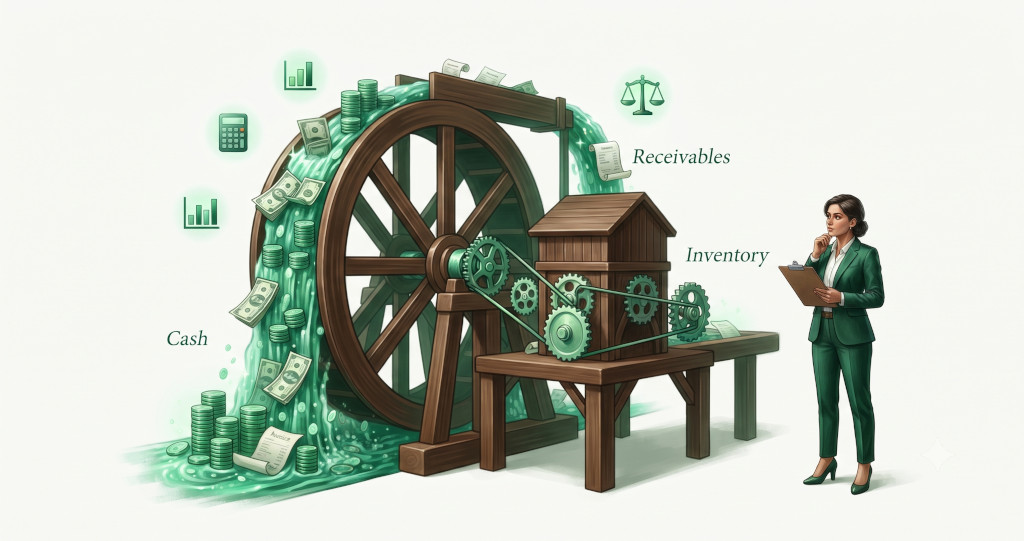
A profitable month on paper and an empty-feeling bank account are not a contradiction — they are two different accounting lenses on the same business. This article unpacks the gap between accrual and cash basis accounting with a worked example, journal entries, and a step-by-step reconciliation so you can stop confusing timing differences with real trouble.
Trade receivables can look healthy on paper right up until a customer collapses and takes a chunk of your profit with them. This guide explains how IFRS 9's expected credit loss model differs from FRS 102's incurred loss approach, and walks through a real provision matrix calculation, journal entries, and the accounting policy choice under paragraph 11.2 that lets FRS 102 preparers apply IFRS 9 instead.
A supplier says the new machine pays for itself in three years, but is that reason enough to spend £120,000? Learn how payback period, NPV and IRR work together to test whether a capital purchase genuinely creates value, with a full worked example and the accounting entries behind it.
R&D tax relief can put real cash back into an SME, but only if you understand which scheme applies and how to record it correctly. This guide breaks down qualifying costs, the merged scheme, ERIS, and a worked £200,000 example with journal entries.
Bank feed categorisation powered by machine learning promises to end the drudgery of manual transaction coding, but how does it actually decide where a payment belongs? This article breaks down the pattern-recognition logic behind AI bookkeeping, walks through a worked example for a small consultancy, and shows why confidence scores — not blind automation — are the key to trustworthy management accounts.
EBIT, EBITDA and net profit are not competing answers to the same question — they are three different lenses on the same set of numbers. This article unpacks what each metric strips out, why lenders and buyers favour different ones, and how a single SME's figures can swing from a £150,000 headline to a £60,345 bottom line depending on which line you stop at.
Bank feed categorisation powered by machine learning promises to end the drudgery of manual transaction coding, but how does it actually decide where a payment belongs? This article breaks down the pattern-recognition logic behind AI bookkeeping, walks through a worked example for a small consultancy, and shows why confidence scores — not blind automation — are the key to trustworthy management accounts.
AI-powered invoice processing turns a typical SME's three-day accounts payable backlog into a same-day task by automating data extraction, three-way matching and coding — while keeping humans in charge of approvals and compliance.
Introduction The integration of Artificial Intelligence (AI) into modern accounting practices is transforming the finance industry. AI technologies are enhancing efficiency, accuracy,…
2 min read
The Weekly Accounting Brief
Standards updates, tax guidance, audit insights, and expert commentary — delivered every Tuesday morning.