Tag: VAT

  • VAT and GST Explained: A Plain-English Guide for SME Owners

    VAT and GST Explained: A Plain-English Guide for SME Owners

    Every business that sells goods or services will encounter VAT or GST at some point — and for many SME owners, indirect tax is where confusion starts to creep in. Unlike income tax, which you pay on what you earn, VAT and GST are collected from your customers, passed through your business, and remitted to the government. That “pass-through” nature sounds straightforward enough, but the practicalities — knowing when to register, what rate to charge, what you can reclaim, and how to file correctly — trip up more business owners than almost any other accounting topic. This guide cuts through the jargon and gives you the essentials.

    What Are VAT and GST — and Are They the Same Thing?

    VAT (Value Added Tax) and GST (Goods and Services Tax) are the same type of tax operating under different names in different countries. VAT is the term used in the United Kingdom, across the European Union, and in many other jurisdictions around the world. GST is used in Australia, New Zealand, Canada, Singapore, India, and elsewhere.

    Both are indirect consumption taxes — meaning the tax is ultimately borne by the final consumer, not by businesses in the supply chain. Registered businesses act as tax collectors on behalf of the government: they charge VAT or GST on their sales, reclaim it on their purchases, and remit the net difference to the tax authority.

    The key principle that distinguishes VAT and GST from a simple sales tax is that tax is applied at every stage of the supply chain — but each business only pays tax on the value it adds at its stage. This prevents the “tax on tax” problem (sometimes called cascading) that affects simpler sales tax systems.

    How VAT Works: Input Tax, Output Tax, and What You Actually Pay

    Understanding VAT comes down to two terms:

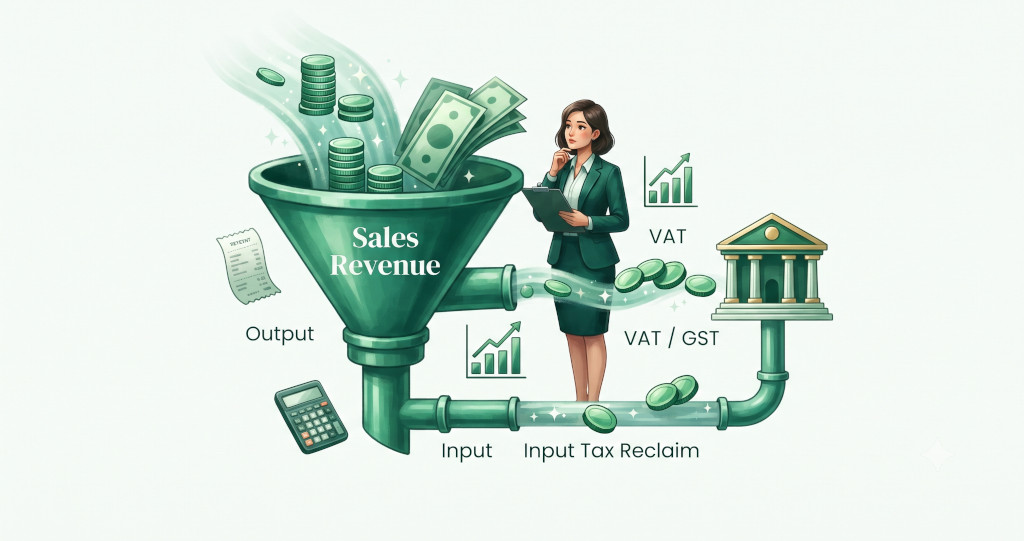
    • Output tax: The VAT you charge your customers on your sales. It flows out of your customers and into your business — but it never belongs to you.
    • Input tax: The VAT you pay to your suppliers on your business purchases. You are entitled to reclaim this from the tax authority (provided you are VAT-registered and the purchases relate to taxable business activities).

    The amount you pay to HMRC (or your country’s equivalent tax authority) each period is simply:

    Net VAT Payable = Output Tax Collected − Input Tax Reclaimed

    Here is a worked example for a UK business operating at the standard 20% VAT rate:

    ItemNet (excl. VAT)VAT (20%)Gross (incl. VAT)
    Sales to customers (output)£50,000£10,000£60,000
    Purchases from suppliers (input)£20,000£4,000£24,000
    Net VAT payable to HMRC£6,000

    In this example, the business collects £10,000 of VAT from its customers, reclaims £4,000 it paid to suppliers, and remits the £6,000 difference to HMRC. The £10,000 it collected was never its own money — it was always being held on the government’s behalf.

    The most common VAT mistake for new business owners is treating the VAT element of their sales revenue as income. It is not — it is tax collected on behalf of the government. Set it aside in a separate bank account or sub-ledger from the day you register, so you are never tempted to spend money that belongs to HMRC.

    It is also worth noting that VAT has a cash flow dimension. You may collect VAT from customers in month one but not remit it to HMRC until the end of your quarterly filing period. That float can be a useful source of short-term liquidity — but only if you have kept the money set aside. Building VAT obligations into your rolling cash flow forecast is essential.

    VAT Registration: When Do You Need to Register?

    In the UK, VAT registration is mandatory once your taxable turnover exceeds the registration threshold over any rolling 12-month period. As of 2024, the UK threshold is £90,000. Once you exceed it, you must register within 30 days. Always verify the current threshold with HMRC, as it is subject to Budget changes.

    Equivalent thresholds in other major economies (verify locally for current figures):

    CountryTax NameStandard RateRegistration Threshold (approx.)
    United KingdomVAT20%£90,000
    AustraliaGST10%AUD $75,000
    New ZealandGST15%NZD $60,000
    CanadaGST / HST5–15%CAD $30,000
    SingaporeGST9%SGD $1,000,000

    Voluntary registration is also available to businesses below the threshold. This can be beneficial if you sell primarily to other VAT-registered businesses (who can reclaim any VAT you charge) or if you incur significant VAT on your purchases that you wish to reclaim. However, voluntary registration does add administrative obligations, so weigh the practical benefits carefully.

    Once registered, you must charge the correct VAT on eligible sales, issue VAT invoices to customers, maintain records of all sales and purchases, and file periodic VAT returns.

    VAT Rates and Exemptions: Not Everything Is Taxed the Same Way

    One of the most important things to understand is that not all goods and services attract VAT at the same rate — and some are not subject to VAT at all. Using the UK as an example, there are four VAT treatments:

    VAT TreatmentRateExamplesCan reclaim input VAT?
    Standard-rated20%Most goods and services, restaurant meals, clothing (adult), electronicsYes
    Reduced-rated5%Domestic energy, children’s car seats, certain health productsYes
    Zero-rated0%Most food, children’s clothing, books, newspapers, most public transportYes
    ExemptN/AFinancial services, insurance, private healthcare, private education, residential property lettingNo

    The distinction between zero-rated and exempt is critical and frequently misunderstood:

    • Zero-rated businesses charge 0% VAT on sales but are still VAT-registered — meaning they can reclaim the input VAT on their own purchases. A bakery selling zero-rated bread can reclaim VAT on its ovens and packaging.
    • Exempt businesses do not charge VAT on sales and cannot reclaim input VAT on purchases. The input tax becomes a cost to the business rather than a reclaimable amount.

    If your business makes both taxable (standard, reduced, or zero-rated) and exempt supplies, you will need to apply partial exemption rules to determine what proportion of your input VAT you can reclaim. This can become technically complex and may warrant specialist advice.

    Filing VAT Returns and Common Mistakes to Avoid

    Most VAT-registered businesses file returns quarterly, though monthly filing is available — particularly useful if you regularly receive refunds (for example, zero-rated businesses that reclaim more input tax than they collect in output tax). In the UK, Making Tax Digital (MTD) for VAT requires all registered businesses to keep digital records and file returns using HMRC-compatible software.

    A typical quarterly VAT return requires you to report:

    1. Total VAT-inclusive sales (output)
    2. Total VAT charged on sales (output tax)
    3. Total VAT-inclusive purchases (input)
    4. Total VAT reclaimed on purchases (input tax)
    5. Net VAT payable or reclaimable

    These figures should flow naturally from well-maintained bookkeeping records. If you find your VAT return figures are difficult to reconcile, that is usually a sign that your bookkeeping needs attention — an important consideration when thinking about the difference between your management accounts and statutory accounts.

    The most common VAT mistakes SME owners make:

    • Missing the registration deadline. If your turnover crosses the threshold and you fail to register in time, HMRC can hold you liable for all the VAT you should have charged — even if you never collected it from customers. Monitor your rolling 12-month turnover closely.
    • Applying the wrong VAT rate. Particularly common in food, construction, and healthcare, where the boundary between standard-rated and zero-rated (or exempt) supplies can be surprisingly fine. When in doubt, check HMRC’s VAT notices for your sector.
    • Claiming input VAT on non-business expenses. You can only reclaim input VAT on purchases that relate to your taxable business activities. Staff entertainment (taking employees out for dinner) is specifically blocked; client entertainment has further restrictions.
    • Missing the quarterly filing deadline. VAT returns are typically due one month and seven days after the end of your VAT period. Late filing attracts surcharges and penalties. Set calendar reminders or use accounting software that prompts you.
    • Poor record-keeping. HMRC can inspect VAT records going back four years (or longer in cases of fraud). You must keep VAT invoices for all purchases on which you reclaim input tax, and issue valid VAT invoices to your customers on all standard or reduced-rated sales.

    VAT compliance becomes considerably easier when it is built into your bookkeeping process from the start rather than left to the end of the quarter. Integrating VAT into your annual budgeting and forecasting process also helps you model the cash flow impact of VAT payments before they arrive.

    Key Takeaways

    • VAT and GST are the same type of indirect consumption tax operating under different names in different countries. Both work on the same input/output mechanism.
    • Output tax is the VAT you charge on sales; input tax is the VAT you pay on purchases. You remit the net difference to the tax authority each period.
    • In the UK, mandatory VAT registration is required once taxable turnover exceeds £90,000 in a rolling 12-month period — monitor this threshold actively.
    • Zero-rated and exempt supplies are very different: zero-rated businesses can reclaim input VAT; exempt businesses cannot.
    • The most costly mistake is treating VAT collected from customers as your own income. It never is — set it aside from day one.
    • File on time, keep digital records, and integrate VAT obligations into your cash flow forecasting to avoid nasty surprises at quarter end.

    Related reading: For more on managing the cash flow implications of VAT, see our guide to cash flow forecasting for SMEs. You may also find our posts on budgeting and forecasting for your financial yearmanagement accounts vs statutory accounts, and the top 10 accounting terms every business owner should know useful next reads.