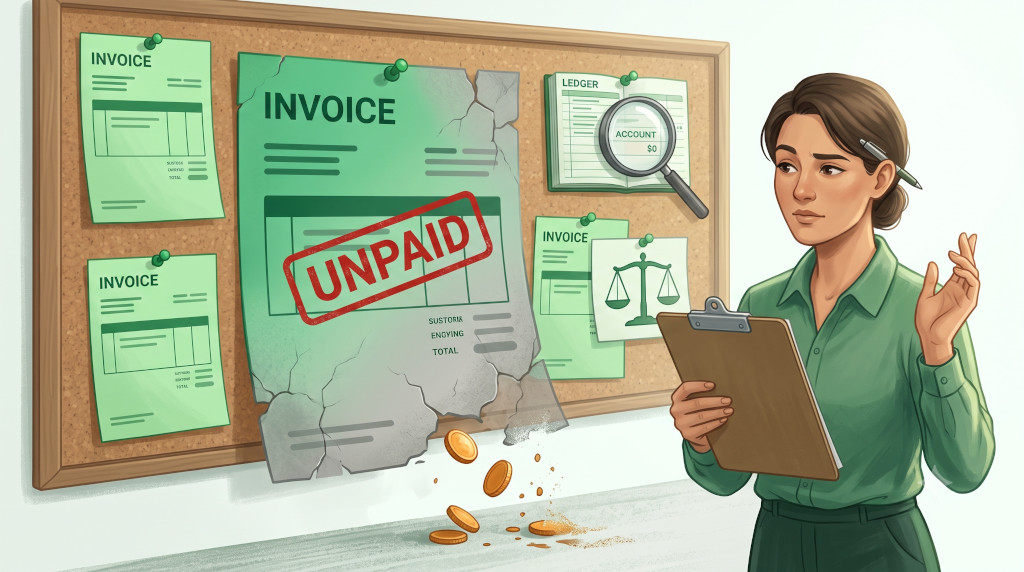
Tag: write-off

  • Bad Debts and Provisions Explained: What to Do When Customers Don’t Pay

    Bad Debts and Provisions Explained: What to Do When Customers Don’t Pay

    Any business that sells on credit — invoicing customers and waiting for payment — will eventually face a customer who does not pay. It might be a long-standing client who runs into financial difficulty, a one-off customer who disputes the invoice, or a debtor who simply disappears. However it happens, the result is the same: money you recorded as income and carried as an asset on your balance sheet may not materialise. How you account for that risk — both before it crystallises and after it does — is the subject of bad debt accounting. Getting it right keeps your financial statements honest and ensures your profit is not overstated by income you are unlikely ever to collect.

    Two Concepts: Bad Debts and Doubtful Debts

    Before getting into the accounting, it is worth being clear on the distinction between two related but different concepts.

    bad debt is a specific debt that you have determined is irrecoverable. You have exhausted reasonable efforts to collect — chased the customer, involved a debt recovery agency, or learned the customer has gone into liquidation — and you have concluded the amount will not be received. At this point, you write the debt off: you remove it from your debtors (accounts receivable) and recognise the loss as an expense.

    doubtful debt is a debt where recovery is uncertain but not yet confirmed as impossible. The customer is overdue, in financial difficulty, or unresponsive — but you have not yet abandoned hope. Rather than waiting for certainty, prudent accounting requires you to create a provision for doubtful debts: an estimate of the amount you may not collect, recognised as an expense now, while the debtor balance remains on the books.

    Key insight: The difference is certainty. A bad debt write-off is definitive — the debt is gone. A provision for doubtful debts is an estimate — the debt is still there on the balance sheet, but its net value is reduced to reflect the risk of non-collection. Both are applications of the prudence concept: do not overstate assets or income.

    Writing Off a Bad Debt: The Accounting Entries

    When you decide a specific debt is irrecoverable and write it off, the journal entry removes the debtor from the balance sheet and records the loss as an expense.

    Assuming a customer owes £1,500 and you have concluded the debt is bad:

    AccountDebitCreditExplanation
    Bad Debt Expense (P&L)£1,500Records the loss as an expense, reducing profit
    Accounts Receivable / Debtors (Balance Sheet)£1,500Removes the uncollectable debt from current assets

    The effect: profit falls by £1,500, and the debtors balance on the balance sheet falls by £1,500. The original sale revenue recorded when the invoice was raised is not reversed — revenue was recognised when earned. The write-off records the subsequent failure to collect as a separate loss.

    What If the Customer Later Pays?

    Occasionally a debt written off is subsequently recovered — the customer pays after all. In this case, you reverse the write-off (reinstating the debtor) and then record the cash receipt in the usual way. The recovery is recorded as income — typically in a “bad debts recovered” account — so it is transparent in the accounts rather than buried.

    Creating a Provision for Doubtful Debts

    A provision takes a forward-looking view: rather than waiting for specific debts to become irrecoverable, you estimate the proportion of your overall debtor book that is unlikely to be collected, and recognise that estimate as a provision (a liability reducing the net debtor balance) before the outcome is known.

    There are two common approaches to calculating the provision.

    Specific Provision

    You identify individual debtors that are at risk and estimate the amount unlikely to be recovered from each. This is the most accurate method and is required under accounting standards (IFRS 9 and FRS 102’s expected credit loss model) for any material balance. For example, if Customer A owes £8,000 and is known to be in administration, you might provide for 80% of the balance: a provision of £6,400.

    General (Percentage) Provision

    Alternatively, you apply a percentage to the aged debtor balance to estimate overall expected losses. The percentage might be based on historical experience — if 2% of your debtors typically prove irrecoverable over time, you provision at 2%. This approach is less precise but practical for businesses with large numbers of small balances where individual assessment is impractical.

    Many businesses use a tiered approach based on how long each debt has been outstanding:

    Age of DebtProvision RateRationale
    0–30 days overdue0%Recent — expected to collect in normal course
    31–60 days overdue5%Slightly late — low but non-zero risk
    61–90 days overdue20%Noticeably overdue — elevated risk
    91–180 days overdue50%Significantly overdue — material risk of loss
    Over 180 days overdue90%Likely irrecoverable — consider specific write-off

    Provision Journal Entries

    When you create or increase a provision for doubtful debts:

    AccountDebitCreditExplanation
    Bad Debt Expense / Doubtful Debt Expense (P&L)£XReduces profit by the estimated loss
    Provision for Doubtful Debts (Balance Sheet — contra asset)£XReduces the net debtor balance presented on the balance sheet

    The provision sits as a contra asset — it does not remove the gross debtor balance (the customer still owes the money), but it reduces the net amount shown, reflecting that not all of it is expected to be collected. On the balance sheet, you might see: Trade Debtors £45,000 less Provision for Doubtful Debts (£2,700) = Net Debtors £42,300.

    At each period end, the provision is reviewed and adjusted — increased if the debtor book has grown or aged, decreased if collections have improved or specific debts have been written off against it.

    Worked Example: Thornfield Design

    Thornfield Design is a creative agency. At 31 March 2026 (year-end), the debtors ledger shows a total balance of £62,000. The bookkeeper analyses the age of the debt and identifies the following:

    CustomerAmount OwedStatusTreatment
    Client A£4,200In liquidation — no recovery expectedWrite off in full as bad debt
    Client B£9,000120 days overdue, disputing invoiceSpecific provision: 50% = £4,500
    Remaining debtors£48,800Mix of 0–90 days overdueGeneral provision at 3% = £1,464

    Step 1 — Write off Client A:
    Debit Bad Debt Expense £4,200 / Credit Debtors £4,200.
    Debtors balance falls to £57,800.

    Step 2 — Create provision for Client B and general book:
    Total provision required: £4,500 + £1,464 = £5,964.
    Debit Doubtful Debt Expense £5,964 / Credit Provision for Doubtful Debts £5,964.

    Balance sheet presentation at 31 March 2026:

    Item£
    Trade debtors (gross, after write-off)57,800
    Less: Provision for doubtful debts(5,964)
    Net trade debtors51,836

    P&L impact: Total bad debt and doubtful debt expense for the year = £4,200 + £5,964 = £10,164, reducing gross profit by that amount.

    VAT on Bad Debts

    For VAT-registered businesses in the UK, there is an additional consideration. When you originally raised the invoice, you paid VAT to HMRC on that sale. If the debt becomes irrecoverable and you write it off, you may be eligible to claim Bad Debt Relief — reclaiming the VAT you already paid over to HMRC on the unpaid invoice. To qualify, the debt must be more than six months old from the date payment was due, must have been written off in your accounts, and you must have originally accounted for VAT on the supply. Keep records of the original invoice, the write-off, and your VAT claim.

    Why This Matters for Your Management Accounts

    Bad debt accounting is not just a year-end tidying exercise — it affects how you read your monthly management accounts throughout the year. An accounts receivable balance that includes large amounts of aged, uncollected debt overstates your current assets and makes the business look more liquid than it actually is. Our guide to accounts receivable and accounts payable covers the broader mechanics of managing your debtor book, including credit terms and collection processes that help prevent bad debts from arising in the first place.

    Running an aged debtor report monthly — and provisioning regularly rather than only at year-end — keeps your management accounts realistic and helps you spot credit risk early, before it becomes a write-off. For groups with multiple entities, ensuring consistent provisioning policies across subsidiaries is important for presenting a reliable consolidated picture; BrizoConsol’s guide on preparing for audit with consolidated financials discusses how these policy consistencies are scrutinised at the group reporting level.


    Key Takeaways

    • bad debt write-off removes a specific irrecoverable debt from the balance sheet and records it as an expense in the P&L, reducing profit. The original revenue is not reversed.
    • provision for doubtful debts estimates the amount of the debtor book unlikely to be collected, recognised as an expense before the outcome is certain. It sits as a contra asset, reducing the net debtor balance on the balance sheet.
    • The journal entries for a write-off: Debit Bad Debt Expense / Credit Debtors. For a provision: Debit Doubtful Debt Expense / Credit Provision for Doubtful Debts.
    • Provisions can be specific (applied to identified at-risk debtors) or general (a percentage applied to the aged debtor book), or a combination of both.
    • Review and adjust your provision at every period end — as debts age, are recovered, or are written off, the provision should move accordingly.
    • VAT-registered businesses in the UK may be able to reclaim VAT on written-off debts via Bad Debt Relief, subject to qualifying conditions.
    • Regular aged debtor reporting and timely provisioning keeps your management accounts honest and surfaces credit risk early.

    Related Reading