Tag: financial ratios

  • Key Financial Ratios Explained: A Complete Guide to Liquidity, Profitability and Efficiency

    Key Financial Ratios Explained: A Complete Guide to Liquidity, Profitability and Efficiency

    Every business produces financial statements, but the numbers alone rarely tell the full story. A company with £500,000 in revenue might be struggling to pay its suppliers on time, while a business turning a modest profit might be sitting on an exceptionally healthy balance sheet. Financial ratios are the analytical tools that bridge that gap — they transform raw figures into meaningful comparisons that reveal how well a business is really performing. Whether you are an SME owner reviewing your own accounts, an accountant advising a client, or a finance professional preparing management reports, understanding how to read and use financial ratios is one of the most valuable skills you can develop.

    What Are Financial Ratios and Why Do They Matter?

    A financial ratio is simply the relationship between two numbers taken from a company’s financial statements — typically the balance sheet, income statement, or cash flow statement. By expressing one figure as a proportion of another, ratios allow you to assess performance in a way that is comparable across periods, industries, and even different-sized businesses.

    For example, knowing that a company made £80,000 in profit tells you very little by itself. Is that good or bad? It depends on the size of the business, the industry, and what it made last year. But expressing it as a net profit margin of 16% — meaning the company keeps 16p of every pound it earns — immediately gives you a benchmark you can compare against competitors and prior years.

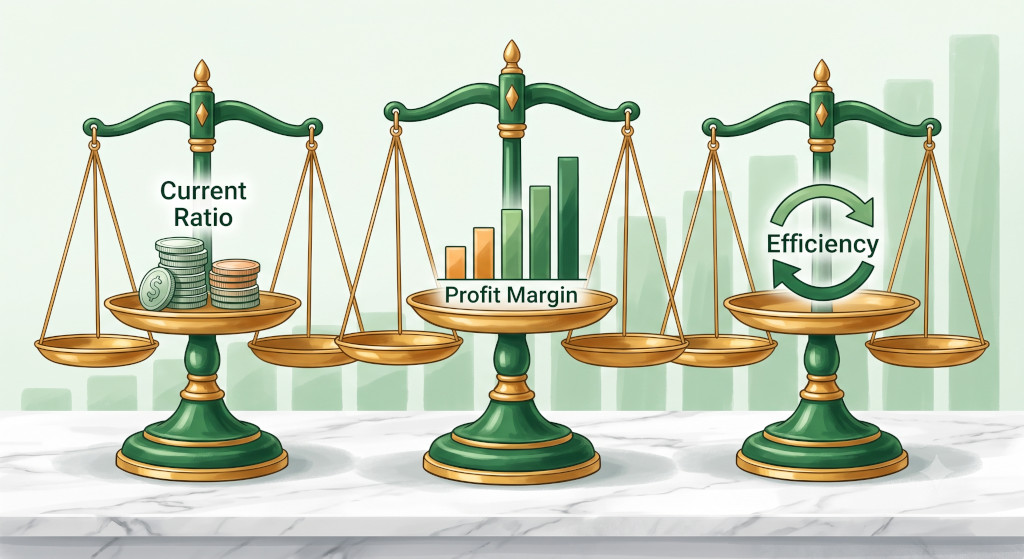
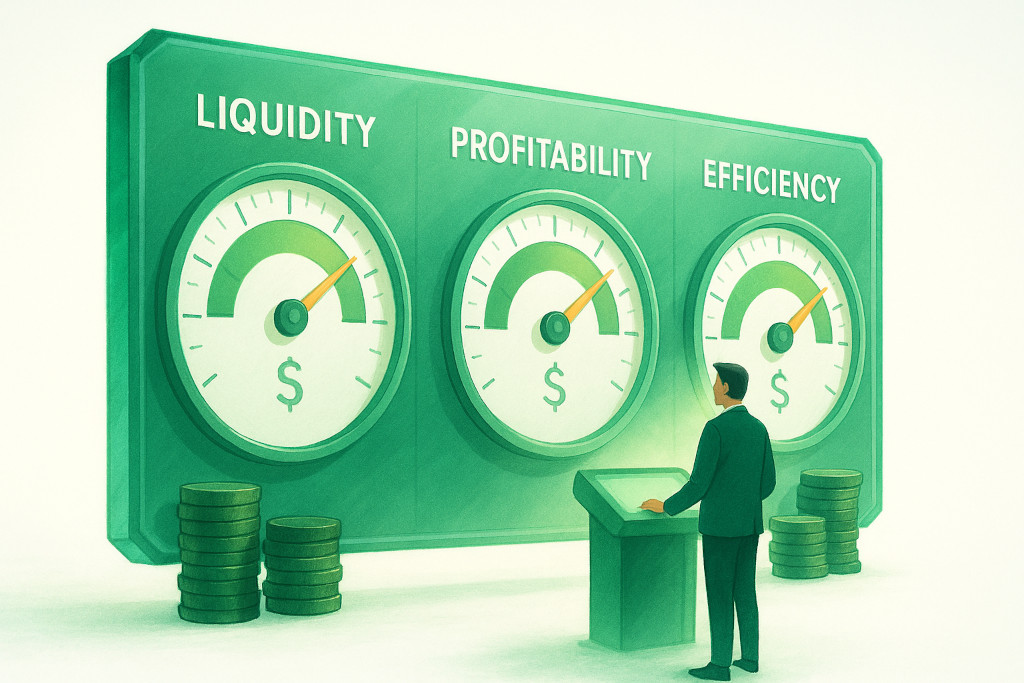
    Financial ratios fall into three main categories: liquidity ratios, which assess whether a business can meet its short-term obligations; profitability ratios, which measure how effectively a business generates profit; and efficiency ratios, which evaluate how well a business uses its assets and manages its operating cycle. Together, they provide a 360-degree view of financial health.

    Liquidity Ratios: Can Your Business Pay Its Bills?

    Liquidity ratios measure a company’s ability to meet its short-term financial obligations — in other words, whether it has enough readily available assets to cover what it owes in the near term. Poor liquidity is one of the most common early warning signs of financial distress, even in otherwise profitable businesses.

    Current Ratio

    The current ratio compares all current assets — cash, receivables, inventory — to all current liabilities due within twelve months.

    Formula: Current Ratio = Current Assets ÷ Current Liabilities

    A ratio above 1.0 indicates the business has more short-term assets than liabilities. Most lenders and analysts look for a current ratio between 1.5 and 2.0. A ratio below 1.0 signals potential liquidity problems; a very high ratio (above 3.0) can suggest assets are not being deployed efficiently.

    Quick Ratio (Acid-Test Ratio)

    The quick ratio is a stricter test that strips out inventory — which may not be quickly convertible to cash — from current assets.

    Formula: Quick Ratio = (Current Assets − Inventory) ÷ Current Liabilities

    A quick ratio of 1.0 or above is generally considered healthy. For businesses with slow-moving stock, such as manufacturers or retailers, this ratio is often more informative than the current ratio.

    Key insight: A business can be profitable on paper and still run out of cash. Liquidity ratios are the earliest warning system — monitor them monthly, not just at year-end.

    Profitability Ratios: Is Your Business Making Money?

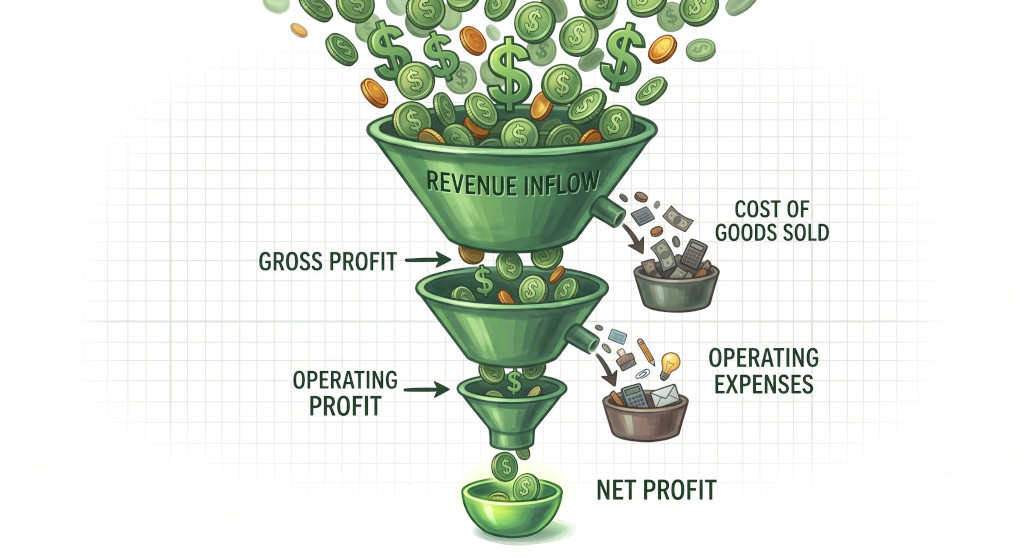
    Profitability ratios measure how efficiently a business converts revenue into profit at different stages of the income statement. They are the clearest indicators of whether the core business model is working — and where value is being lost.

    Gross Profit Margin

    Formula: Gross Profit Margin = (Revenue − Cost of Goods Sold) ÷ Revenue × 100

    This ratio shows how much profit a business retains after covering the direct costs of producing its goods or services. A declining gross margin over time often signals rising input costs, supplier price increases, or unsustainable discounting — issues that need to be addressed before they erode the bottom line.

    Net Profit Margin

    Formula: Net Profit Margin = Net Profit After Tax ÷ Revenue × 100

    The net profit margin captures what remains after all costs — including overhead, depreciation, interest, and tax — have been deducted. It is the most comprehensive measure of overall profitability. Industry benchmarks vary significantly: a supermarket might operate on 2–3%, while a software business might target 20% or more.

    Return on Assets (ROA)

    Formula: ROA = Net Profit ÷ Total Assets × 100

    ROA indicates how effectively management is using the company’s asset base to generate earnings. A higher ROA reflects greater efficiency in deploying capital.

    Return on Equity (ROE)

    Formula: ROE = Net Profit ÷ Shareholders’ Equity × 100

    ROE measures the return generated on the funds invested by shareholders. It is one of the most closely watched ratios by investors and business owners alike, as it reflects how much profit the business is generating per pound of owner capital.

    Efficiency Ratios: How Well Are You Using Your Resources?

    Efficiency ratios — sometimes called activity ratios or operating ratios — examine how effectively a business manages its assets and liabilities in its day-to-day operations. They are particularly useful for identifying cash flow problems hidden within the operating cycle.

    Receivables Days (Days Sales Outstanding — DSO)

    Formula: DSO = (Trade Receivables ÷ Revenue) × 365

    This tells you, on average, how many days it takes to collect payment from customers. If your payment terms are 30 days but your DSO is 52 days, you have a collections problem that is directly straining your cash flow.

    Payables Days (Days Payable Outstanding — DPO)

    Formula: DPO = (Trade Payables ÷ Cost of Goods Sold) × 365

    DPO measures how long a business takes to pay its suppliers. A higher DPO can indicate effective cash management — using supplier credit as a free source of finance — but if it stretches too far, it risks damaging supplier relationships.

    Inventory Turnover

    Formula: Inventory Turnover = Cost of Goods Sold ÷ Average Inventory

    This ratio shows how many times a business sells and replaces its inventory in a given period. A high turnover suggests efficient stock management; a low turnover points to excess stock, slow-moving product lines, or potential obsolescence.

    Quick Reference: Key Ratios at a Glance

    RatioFormulaWhat It MeasuresHealthy Range (General Guide)
    Current RatioCurrent Assets ÷ Current LiabilitiesShort-term liquidity1.5 – 2.0
    Quick Ratio(Current Assets − Inventory) ÷ Current LiabilitiesLiquid-only coverage1.0 or above
    Gross Profit Margin(Revenue − COGS) ÷ Revenue × 100Profitability after direct costsVaries by industry
    Net Profit MarginNet Profit ÷ Revenue × 100Overall profitabilityVaries by industry
    Return on AssetsNet Profit ÷ Total Assets × 100Asset efficiency5%+ (higher = better)
    Return on EquityNet Profit ÷ Shareholders’ Equity × 100Return on owner capital15%+ (higher = better)
    DSO (Receivables Days)(Receivables ÷ Revenue) × 365Speed of collectionsClose to your payment terms
    DPO (Payables Days)(Payables ÷ COGS) × 365Supplier payment timingBalanced with DSO
    Inventory TurnoverCOGS ÷ Average InventoryStock management efficiencyHigher = better (sector-dependent)

    Worked Example: Ratios in Practice

    Consider a small manufacturing business, Greenfield Components Ltd, with the following figures for its most recent financial year:

    • Revenue: £1,200,000
    • Cost of Goods Sold: £720,000
    • Net Profit After Tax: £96,000
    • Current Assets: £380,000 (including Inventory of £120,000)
    • Current Liabilities: £210,000
    • Total Assets: £650,000
    • Shareholders’ Equity: £320,000
    • Trade Receivables: £140,000
    • Trade Payables: £85,000

    Running through the key ratios:

    • Current Ratio: 380,000 ÷ 210,000 = 1.81 — healthy liquidity position
    • Quick Ratio: (380,000 − 120,000) ÷ 210,000 = 1.24 — comfortable even without inventory
    • Gross Profit Margin: (1,200,000 − 720,000) ÷ 1,200,000 × 100 = 40%
    • Net Profit Margin: 96,000 ÷ 1,200,000 × 100 = 8%
    • Return on Assets: 96,000 ÷ 650,000 × 100 = 14.8%
    • Return on Equity: 96,000 ÷ 320,000 × 100 = 30% — strong return for shareholders
    • DSO: (140,000 ÷ 1,200,000) × 365 = 42.6 days — slightly above 30-day terms; worth monitoring
    • DPO: (85,000 ÷ 720,000) × 365 = 43.1 days — balanced with DSO; no significant working capital gap

    Overall, Greenfield Components looks financially sound — profitable, liquid, and generating solid returns. The slight overrun on receivables days is the one area worth investigating: if the company could bring DSO down to 35 days, it would free up approximately £17,000 in additional cash flow.

    For businesses managing multiple entities or subsidiaries, tracking ratios at the consolidated group level — as well as entity by entity — provides even richer insight. BrizoConsol’s accountant’s guide to group reporting covers how finance teams can produce consolidated financial statements efficiently, giving ratio analysts the clean, reliable data they need.

    How to Use Financial Ratios Effectively

    Ratios are most powerful when used comparatively — not as one-off snapshots. There are three lenses through which to apply them:

    1. Trend analysis: Compare the same ratio across multiple periods for your own business. A current ratio falling from 2.1 to 1.4 over three years tells a story, even if 1.4 is still technically “acceptable”.
    2. Industry benchmarks: Compare your ratios against sector averages. A 5% net margin is weak for a software company but strong for a supermarket chain. Industry bodies, credit reference agencies, and trade associations often publish benchmark data.
    3. Competitor comparison: Where public financial statements are available, comparing ratios against direct competitors reveals relative strengths and weaknesses in operations, pricing power, and financial management.

    It is also worth remembering that ratios are derived from historical financial statements — they describe where you have been, not necessarily where you are going. Use them alongside cash flow forecasts and budget variance analysis for a forward-looking picture.


    Key Takeaways

    • Financial ratios convert raw accounting figures into meaningful benchmarks for performance analysis.
    • Liquidity ratios (current ratio, quick ratio) reveal whether a business can meet its short-term obligations — monitor these monthly.
    • Profitability ratios (gross margin, net margin, ROA, ROE) measure how effectively the business converts revenue into profit and returns value to owners.
    • Efficiency ratios (DSO, DPO, inventory turnover) highlight how well the business manages its working capital cycle.
    • Ratios are most useful when tracked over time, compared against industry benchmarks, and used alongside forecasts.
    • A single ratio rarely tells the whole story — always interpret ratios together for a balanced view.

    Related reading: Financial ratios draw on all three core financial statements. If you want to deepen your understanding of the numbers that feed into ratio analysis, explore our guides to the key sources: the balance sheet and its structurethe income statement explained for SMEs, and understanding the cash flow statement. For a broader introduction to accounting principles, Accounting Made Simple is a good place to start.