
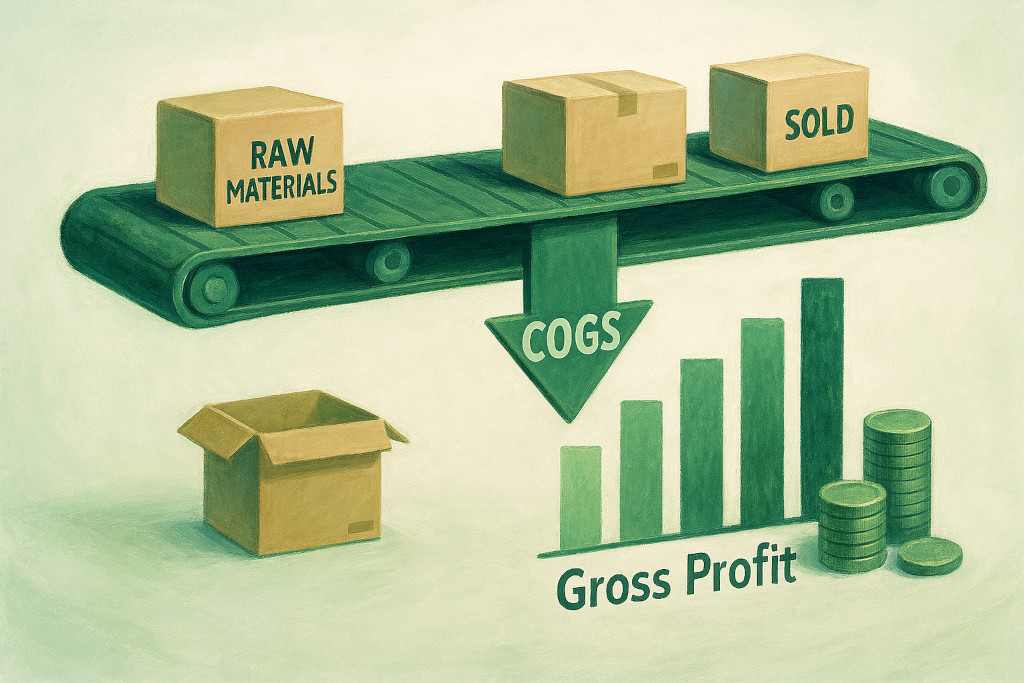
If your business sells a physical product — or buys in goods to resell — then Cost of Goods Sold is one of the most important numbers on your income statement. It represents the direct cost of producing or acquiring the goods your business actually sold during a period. Get it right and you have a clear view of how efficiently your business converts purchases into revenue. Get it wrong and every margin calculation, every pricing decision, and every profitability report you produce is built on sand. This guide explains exactly what COGS is, how to calculate it, how it sits within the P&L, and how to use it to make sharper business decisions.
What Is Cost of Goods Sold?
Cost of Goods Sold — sometimes called Cost of Sales (COS) — is the total direct cost incurred to produce or purchase the goods that a business sold during a specific accounting period. It sits on the income statement directly below revenue, and subtracting it from revenue gives you gross profit.
The word “direct” is important here. COGS includes only the costs that can be traced directly to the production or purchase of the goods sold. It does not include indirect overheads such as rent, marketing, or the salaries of your finance team — those sit further down the P&L as operating expenses.
What counts as a direct cost depends on your business model:
| Business Type | Typical COGS Components |
|---|---|
| Retailer / Wholesaler | Purchase price of goods, import duties, freight-in costs |
| Manufacturer | Raw materials, direct labour, factory overhead (machine depreciation, factory rent) |
| Food & Beverage | Ingredients, packaging, direct kitchen labour |
| Software / SaaS | Hosting costs, payment processing fees, third-party licences consumed per customer |
| Service Business | COGS may not apply, or may include direct staff costs billed to projects |
Pure service businesses — accountants, consultants, lawyers — typically do not have COGS in the traditional sense. Their “cost of delivering the service” is often captured separately as cost of revenue or direct staff costs, though the label varies by convention and industry.
How to Calculate COGS: The Opening Stock Formula
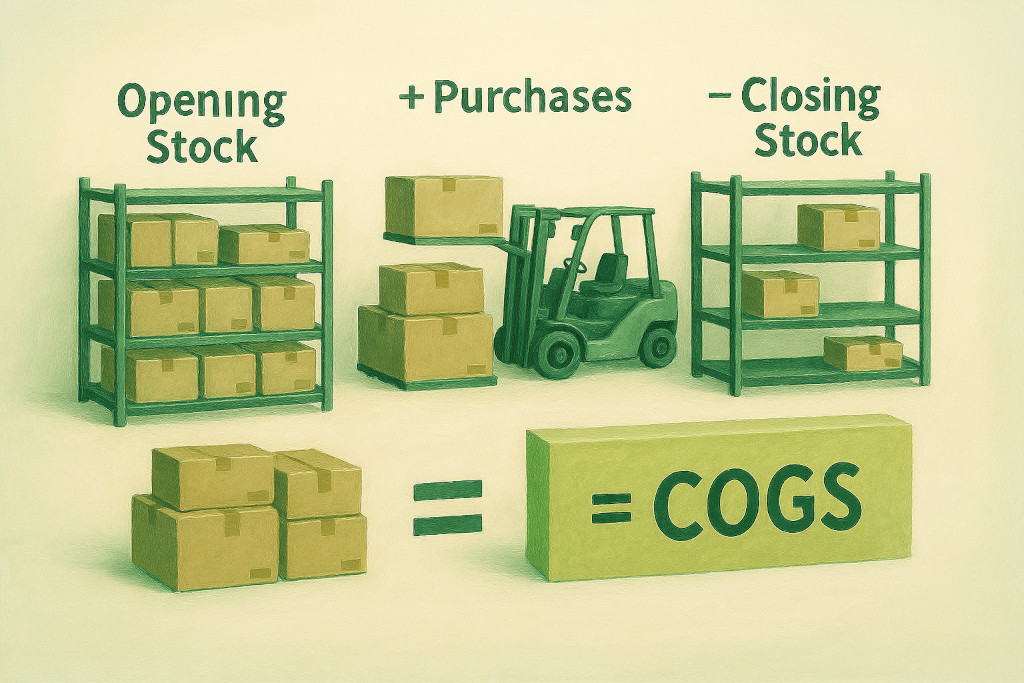
For businesses that hold physical inventory, COGS is calculated using the opening stock formula:
COGS = Opening Stock + Purchases During the Period − Closing Stock
This formula works because it captures precisely the cost of goods that left your warehouse as sales — not the cost of everything you bought, and not the cost of what you still hold.
Let us put numbers on it. Suppose Oakfield Trading Ltd has the following inventory position for the year ended 31 March 2026:
| Item | Amount (£) |
|---|---|
| Opening stock (1 April 2025) | 48,000 |
| Purchases during the year | 312,000 |
| Closing stock (31 March 2026) | (55,000) |
| Cost of Goods Sold | 305,000 |
Oakfield had £48,000 of stock at the start of the year, bought £312,000 of goods, but still held £55,000 at year end. The remaining £305,000 represents the cost of goods that were actually sold — and that is what appears on the income statement.
Inventory Valuation Methods
To calculate closing stock — and therefore COGS — you need a method for valuing the inventory you still hold. The three most common approaches are:
- FIFO (First In, First Out): Assumes the oldest stock is sold first. In a rising-price environment, this produces a lower COGS and higher gross profit, as earlier (cheaper) costs are matched against revenue first.
- AVCO (Average Cost): Uses a weighted average of all units available. Smooths out price fluctuations and is widely used for commodities and similar goods.
- LIFO (Last In, First Out): Assumes the newest stock is sold first. Produces higher COGS in rising markets. Note that LIFO is not permitted under IFRS and is therefore rarely used in the UK, Australia, or most jurisdictions that follow international standards — though it remains permitted under US GAAP.
The method you choose has a direct effect on both your reported profit and your balance sheet inventory value. It is important to apply the same method consistently from one period to the next, changing it only when there is a genuine and disclosed reason to do so.
Gross Profit Margin: What COGS Tells You About Your Business
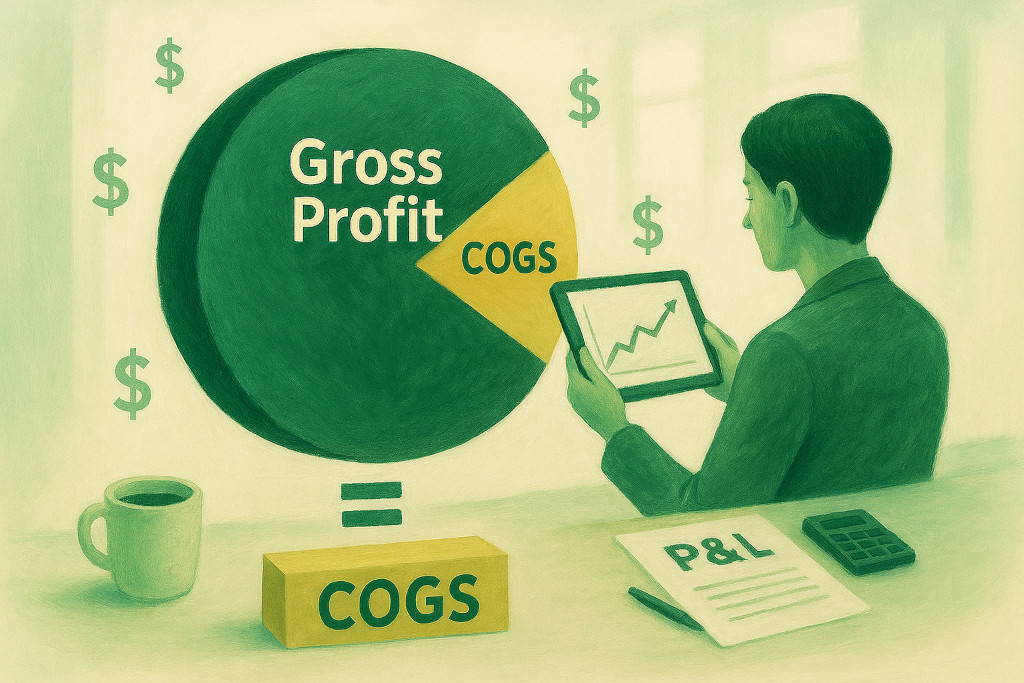
Once you have COGS, you can calculate the two most important profitability metrics on the income statement: gross profit and gross profit margin.
| Metric | Formula | Oakfield Example |
|---|---|---|
| Gross Profit | Revenue − COGS | £500,000 − £305,000 = £195,000 |
| Gross Profit Margin | (Gross Profit ÷ Revenue) × 100 | (£195,000 ÷ £500,000) × 100 = 39% |
A 39% gross margin means that for every £1 of revenue, Oakfield retains 39p before paying any of its operating costs (rent, salaries, marketing, and so on). The remaining 61p goes directly to fund the cost of the goods sold.
Gross margin is one of the most powerful benchmarking metrics available. Tracking it over time immediately signals whether your pricing or purchasing is drifting — a falling gross margin can mean suppliers have increased their prices and you have not passed them on, or that product mix is shifting towards lower-margin lines. The ARD guide on key financial ratios covers gross margin alongside the full suite of profitability, liquidity, and efficiency metrics.
COGS on the Income Statement
Understanding where COGS sits within the P&L helps you read financial statements with much greater clarity. A standard SME income statement flows as follows:
| Line | £ |
|---|---|
| Revenue (Turnover) | 500,000 |
| Less: Cost of Goods Sold | (305,000) |
| Gross Profit | 195,000 |
| Less: Operating Expenses (rent, salaries, marketing, etc.) | (140,000) |
| Operating Profit (EBIT) | 55,000 |
| Less: Interest & tax | (12,000) |
| Net Profit | 43,000 |
COGS is the first deduction from revenue and therefore sets the ceiling for everything that follows. A business with a structurally high COGS relative to revenue will always struggle to reach a healthy net profit, no matter how tightly it controls overhead. This is why pricing strategy, supplier negotiation, and production efficiency all ultimately show up in this one line. For a deeper walkthrough of the full P&L structure, the ARD guide to understanding the income statement covers each section in detail.
Gross margin is not just a reporting metric — it is a business health signal. If your gross margin is shrinking quarter by quarter and you have not changed your pricing, something in your cost base is moving against you. COGS is where you find out what.
Finance teams working across multiple entities — for example, a group where one subsidiary manufactures goods and sells them to a sibling trading company — need to be careful that intercompany sales do not inflate both revenue and COGS at the group level. BrizoConsol’s guide to the practical use of financial reporting for SMEs discusses how meaningful reporting requires eliminating this kind of internal noise to produce accounts that reflect genuine external activity.
Common COGS Mistakes to Avoid
Even experienced business owners make consistent errors when it comes to COGS. These are the most frequent:
- Including overhead costs in COGS. Rent, utilities, and management salaries belong below the gross profit line as operating expenses — not in COGS — unless they are directly and exclusively tied to production (e.g. a factory-floor manager’s salary vs. the CEO’s salary).
- Forgetting freight-in. The cost of getting goods to your warehouse (inbound shipping, import duties) is part of the cost of acquiring those goods and belongs in COGS. Outbound shipping to customers is typically an operating expense.
- Not adjusting for stock write-offs. If goods are damaged, expired, or obsolete, the write-off should flow through COGS or as a separate line near it — not be quietly ignored. Overstating closing stock understates COGS and overstates profit.
- Mixing up cash paid vs. cost of goods sold. The cash you paid to suppliers this period is not the same as COGS for this period. If you bought £100,000 of stock but only sold goods with a cost of £70,000, your COGS is £70,000 — the other £30,000 is an asset (closing stock) on the balance sheet.
- Inconsistent inventory counts. COGS depends on an accurate closing stock figure. Without a reliable stock count or perpetual inventory system, your gross margin figures are unreliable and comparisons between periods are meaningless.
Key Takeaways
- Cost of Goods Sold (COGS) is the direct cost of producing or purchasing the goods a business actually sold during a period.
- The formula is: Opening Stock + Purchases − Closing Stock = COGS.
- COGS sits immediately below revenue on the income statement; Revenue minus COGS equals Gross Profit.
- Gross profit margin (Gross Profit ÷ Revenue) is one of the most important indicators of business pricing strength and cost efficiency.
- Inventory valuation method (FIFO, AVCO, or LIFO) affects both COGS and the balance sheet stock figure — apply it consistently.
- Common errors include including overhead in COGS, forgetting freight-in, and failing to write off obsolete stock.
Related Reading
COGS is one piece of a larger picture. To see how it fits into the full income statement, read the ARD guide to understanding the income statement. To understand how gross margin compares to other key ratios, the key financial ratios guide puts profitability metrics in context alongside liquidity and efficiency measures. And because COGS affects the balance sheet through inventory valuation, our guide to the balance sheet explains exactly where closing stock sits and how it is presented.



[…] You can read more about how COGS is calculated and why it matters in our guide to Cost of Goods Sold explained. […]