
Hiring your first employee is a milestone — but it also marks the moment your accounting gets significantly more complicated. Suddenly you’re not just recording invoices and payments. You’re managing gross pay, income tax deductions, National Insurance contributions from both sides, pension obligations, and a monthly payment to HMRC that has to be right. Many small business owners leave payroll entirely to their software or accountant and never look at what’s actually being recorded in the books. That’s a mistake. Understanding how payroll flows through your accounts gives you a clearer picture of your true employment costs, helps you spot errors, and makes you a more informed reader of your own financial statements.
The Anatomy of a Payslip
Before you can record payroll in your accounts, you need to understand what a payslip actually contains — because each element is treated differently in the bookkeeping.
Gross pay is what the employee earns before any deductions. This is the figure agreed in their employment contract — whether monthly salary, hourly rate, or a combination of basic pay and additional elements like overtime or bonuses.
Employee deductions are amounts withheld from the employee’s gross pay before the net amount is paid to them. The two main deductions for most employees are income tax (collected under the Pay As You Earn system — PAYE) and the employee’s National Insurance Contribution (employee NIC). For employees enrolled in a workplace pension, their pension contribution is also deducted here.
Net pay is what the employee actually receives in their bank account — gross pay minus all employee deductions.
But from an accounting perspective, the payslip only tells half the story. The employer also has obligations that appear nowhere on the employee’s payslip.
The True Cost of an Employee

What the employee earns and what the employment actually costs the business are two different figures. The difference is the employer’s on-costs — specifically employer’s National Insurance Contributions and employer pension contributions.
Employer NIC is a separate charge on the employer, calculated as a percentage of the employee’s earnings above the secondary threshold. Unlike employee NIC (which reduces the employee’s take-home pay), employer NIC is an additional cost on top of gross pay — it does not appear on the payslip at all, but it absolutely appears in the business’s accounts as an expense.
Employer pension contributions are the minimum amounts the employer is required to contribute under auto-enrolment — currently a minimum of 3% of qualifying earnings — on top of the employee’s own contributions.
A common shock for first-time employers: an employee on a £35,000 salary doesn’t cost £35,000 a year. Once employer NIC and pension are added, the actual employment cost is closer to £38,500–£40,000 depending on the pension contribution rate. This distinction matters enormously for budgeting and for understanding your true staffing costs.
Worked Example — Maplewood Studio Ltd
Maplewood Studio Ltd employs a graphic designer on a gross monthly salary of £3,000. The table below breaks down the full payroll picture for a single month, including the deductions from the employee’s pay and the additional employer costs.
| Item | Amount (£) | Who Bears the Cost |
|---|---|---|
| EMPLOYEE’S PAYSLIP | ||
| Gross Pay | 3,000.00 | Employee earns |
| Less: Income Tax (PAYE) | (420.00) | Deducted from employee |
| Less: Employee NIC (Class 1) | (195.00) | Deducted from employee |
| Less: Employee Pension (5%) | (150.00) | Deducted from employee |
| Net Pay to Employee | 2,235.00 | Paid to employee’s bank |
| EMPLOYER’S ADDITIONAL COSTS | ||
| Employer NIC (Class 1) | 285.00 | Additional employer cost |
| Employer Pension (3%) | 90.00 | Additional employer cost |
| Total Employment Cost | 3,375.00 | Total business cost per month |
The employee takes home £2,235. The business pays out £3,375 in total — £2,235 to the employee, £615 to HMRC (PAYE £420 + employee NIC £195 + employer NIC £285), and £240 to the pension scheme (employee contribution £150 + employer contribution £90). The gross salary of £3,000 is just the starting point, not the total cost.
Note: The figures above are illustrative. Actual PAYE and NIC amounts depend on the employee’s tax code, their earnings above the Primary Threshold (for employee NIC) and Secondary Threshold (for employer NIC), and other factors including age and employment allowances.
The Payroll Journal Entries
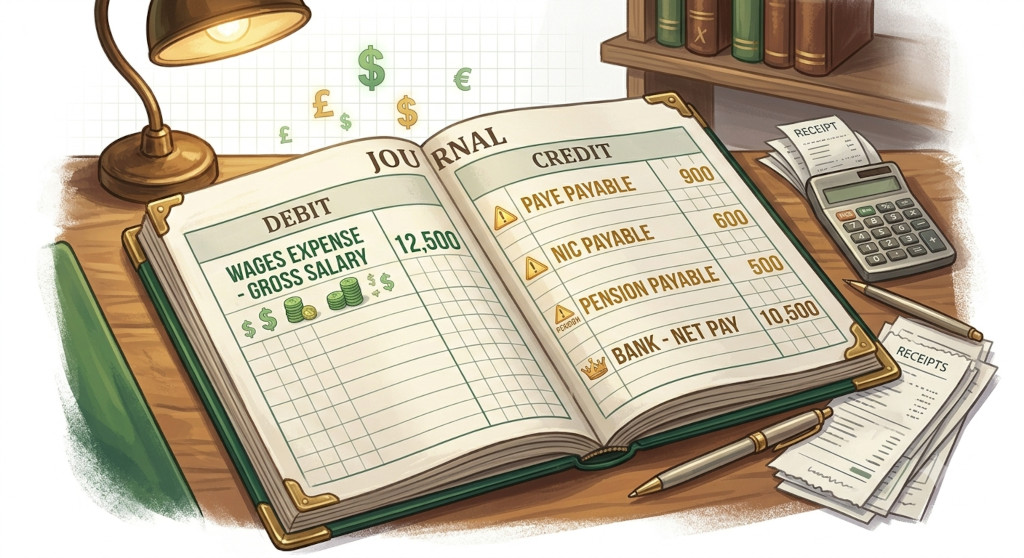
Payroll is recorded through two separate journal entries. The first recognises the expense and creates the liabilities. The second clears those liabilities when the cash payments go out.
Journal Entry 1 — Recording the Payroll
Posted on the pay date (or period end), this entry records the full cost of employment and creates liabilities owed to the employee, HMRC, and the pension provider.
| Account | Debit (£) | Credit (£) | Explanation |
|---|---|---|---|
| Wages Expense | 3,000.00 | Gross salary cost | |
| Employer NIC Expense | 285.00 | Employer NIC on-cost | |
| Employer Pension Expense | 90.00 | Employer pension contribution | |
| Net Wages Payable | 2,235.00 | Amount owed to employee | |
| PAYE / NIC Payable | 900.00 | PAYE £420 + emp NIC £195 + er NIC £285 | |
| Pension Payable | 240.00 | Employee £150 + employer £90 | |
| Total | 3,375.00 | 3,375.00 | Balanced ✓ |
Journal Entry 2 — Making the Payments
When payments leave the bank — net pay to the employee, PAYE/NIC to HMRC, and pension to the scheme — the liabilities are cleared.
| Account | Debit (£) | Credit (£) | Explanation |
|---|---|---|---|
| Net Wages Payable | 2,235.00 | Clearing employee liability | |
| PAYE / NIC Payable | 900.00 | Clearing HMRC liability | |
| Pension Payable | 240.00 | Clearing pension liability | |
| Bank / Current Account | 3,375.00 | Total cash out of bank | |
| Total | 3,375.00 | 3,375.00 | Balanced ✓ |
The two-entry approach exists because of timing. The employee is paid at month end, but the PAYE/NIC payment to HMRC is due by the 19th of the following month (22nd for electronic payment). Splitting the entries correctly creates the liability when the obligation arises, and clears it only when cash actually leaves the bank.
How Payroll Appears in Your Financial Statements
After these entries are posted, payroll costs flow through the financial statements as follows.
On the income statement, the full employment cost — gross wages £3,000, employer NIC £285, employer pension £90 — appears as an operating expense, reducing operating profit by £3,375 for the period. The net pay figure of £2,235 tells you nothing meaningful about the business cost; it is the total employment cost that matters for profit analysis.
On the balance sheet, any outstanding payroll liabilities (PAYE/NIC not yet paid to HMRC, net pay not yet transferred) sit as current liabilities until the payments clear. After all payments are made, no residual payroll liability remains for that month.
On the cash flow statement, the payments to the employee, HMRC, and the pension scheme appear as operating cash outflows in the period they are made — which may straddle month-end if PAYE is paid in the following month. Our guide to accruals and prepayments covers how timing differences between expense recognition and cash payment are handled more broadly.
Key Takeaways
- An employee’s net pay is not the total cost of employment. Add employer NIC and employer pension on top of gross salary to find the true employment cost — the figure that hits your income statement.
- Payroll is recorded in two journal entries: one to recognise the expense and create liabilities (on pay date), and one to clear those liabilities when the cash payments leave the bank.
- Employee deductions (PAYE, employee NIC, employee pension) are withheld from the employee’s gross pay and held as liabilities until remitted to HMRC and the pension scheme — they are the employer’s responsibility to collect and pay over, but not the employer’s expense.
- PAYE and NIC must reach HMRC by the 19th of the month following the payroll date (22nd electronically). Late payment attracts interest and penalties.
- Understanding the full employment cost — not just the salary line — is essential for accurate budgeting, pricing, and financial analysis.
Related reading: If you found this guide useful, you may also want to read our posts on double-entry bookkeeping explained, accruals and prepayments explained, chart of accounts for SMEs, and understanding the income statement.