When a business spends money, not every payment is treated the same way in the accounts. A £300 printer cartridge and a £30,000 piece of manufacturing equipment are both costs — but they land in completely different places in your financial statements, affect your profit in entirely different ways, and have different tax implications. The distinction that determines how each is treated is one of the most fundamental in accounting: is this capital expenditure or revenue expenditure? Getting this right matters not just for producing accurate accounts, but for ensuring you claim the right tax reliefs at the right time and present an honest picture of your business’s assets and profitability.
What Is Capital Expenditure?
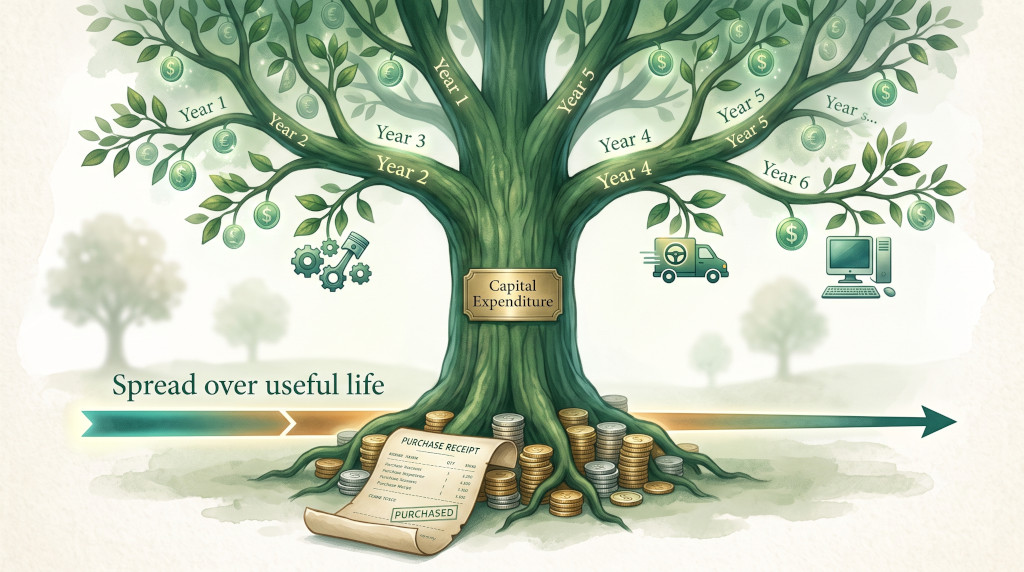
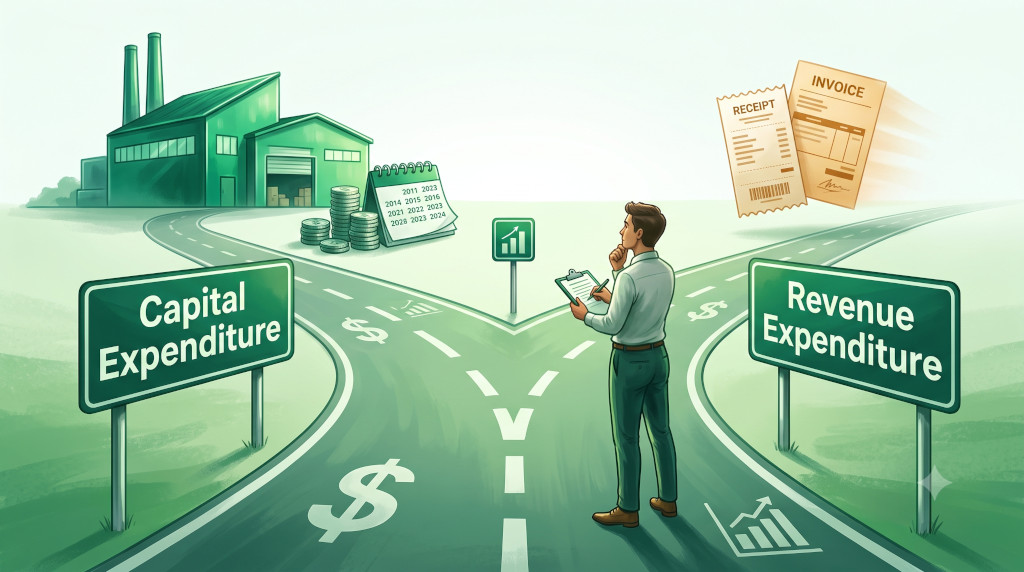
Capital expenditure (CapEx) is spending on assets that will provide economic benefit to your business over more than one accounting period. When you buy a piece of machinery, a company vehicle, a building, computer equipment, or any other asset with a multi-year useful life, that is capital expenditure.
The defining characteristic is duration: the asset will contribute to generating revenue not just now, but in future periods too. Because of this, accounting standards require that the cost is not written off immediately against profit. Instead, it is recognised as an asset on the balance sheet and then gradually expensed over the asset’s useful life through depreciation. This matching of cost to benefit — spreading the expenditure across the periods in which the asset earns its keep — is the practical application of the matching principle discussed in our guide to double-entry bookkeeping and journal entries.
Common examples of capital expenditure include property purchases or improvements, machinery and equipment, vehicles, computer hardware, leasehold improvements, and the development costs of software or other intangible assets (subject to specific criteria).
What Is Revenue Expenditure?
Revenue expenditure (sometimes called operational expenditure or OpEx) is spending that is consumed within the current accounting period. It relates to the day-to-day running of the business: rent, utilities, wages, stationery, repairs, insurance, advertising, and similar costs. These expenses are charged directly to the profit and loss account in the period they are incurred, reducing profit immediately.
The key distinction from capital expenditure is that revenue expenditure either has no lasting economic benefit beyond the current period, or it relates to maintaining an existing asset rather than enhancing it. Painting your office walls is revenue expenditure (maintenance). Adding a new floor to the building is capital expenditure (enhancement).
Key insight: The question to ask is: does this spending create or enhance a long-term asset, or does it simply keep the business running today? If it creates lasting value — it is CapEx, and it goes on the balance sheet. If it keeps operations running without creating a new asset — it is revenue expenditure, and it goes straight to the P&L.
How the Classification Affects Your Accounts
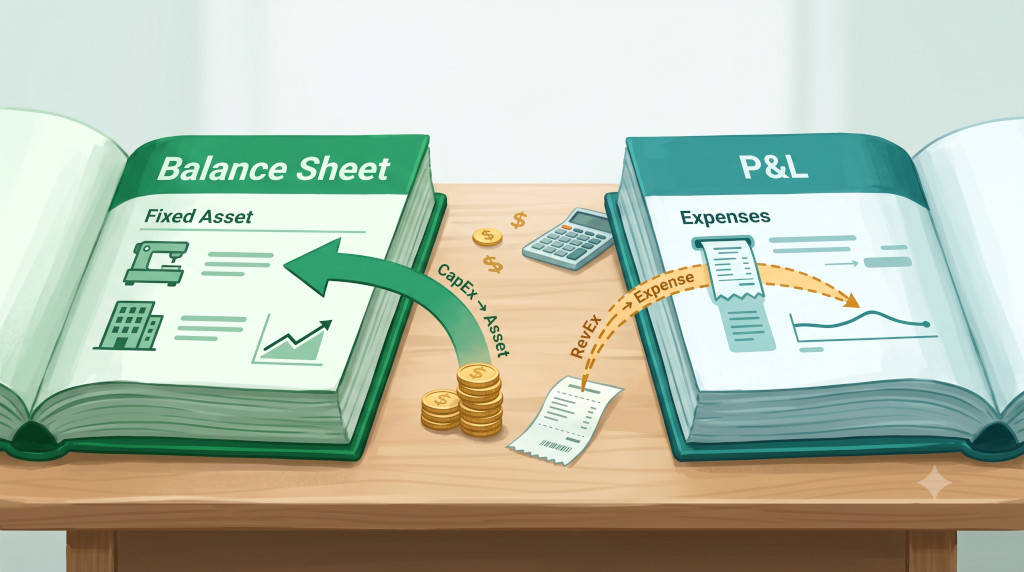
The accounting treatment for each type of expenditure is fundamentally different, and the impact flows through both the balance sheet and the profit and loss account.
| Feature | Capital Expenditure | Revenue Expenditure |
|---|---|---|
| Where it goes | Balance sheet (fixed assets) | Profit & Loss account (expenses) |
| Profit impact | Spread over useful life via depreciation | Reduces profit immediately in full |
| Cash impact | Full cash outflow on purchase date | Full cash outflow when paid |
| Balance sheet effect | Increases fixed assets (gross); reduces via accumulated depreciation | No balance sheet entry (passes through P&L) |
| Tax treatment (UK example) | Capital allowances claimed over time | Deducted in full in the year incurred |
| Example | Buying a delivery van for £25,000 | Insuring that van for £1,200 per year |
Note an important nuance: the cash impact is the same on day one regardless of classification. The company pays £25,000 for the van — the cash leaves the bank immediately. The difference is purely in how that outflow is recognised in the accounts: gradually through depreciation (CapEx) or all at once (revenue expenditure). This is why a business can be profitable on paper but still face cash pressure after a major capital investment — the profit and loss account only shows the year’s depreciation charge, while the full purchase price has already left the bank account.
The Tax Dimension: Why Getting This Right Matters
Misclassifying capital and revenue expenditure has direct tax consequences. In the UK, revenue expenditure is deductible in full in the accounting period it is incurred — reducing your taxable profit pound for pound. Capital expenditure is not deducted as an expense; instead, you claim capital allowances, which are the tax equivalent of depreciation (though calculated using HMRC’s own rates rather than your accounting depreciation charge).
The Annual Investment Allowance (AIA) allows most SMEs to deduct the full cost of qualifying capital expenditure in the year of purchase — which can be highly tax-efficient. But to claim it, the expenditure must first be correctly classified as capital. If a business mistakenly treats capital expenditure as a revenue expense, it may claim a deduction it is not entitled to — which can result in penalties if HMRC identifies the error. Conversely, if it treats revenue expenditure as capital, it will under-claim in the current year and over-state its asset base.
The tax rules vary by jurisdiction, so always confirm the treatment that applies to your business with a qualified accountant — but the principle that classification affects both your accounts and your tax position is universal.
Worked Example: Birchwood Bakery
Birchwood Bakery is a small food production business. In the financial year ending 31 March 2026, it incurs the following expenditures. The owner needs to classify each correctly before preparing the accounts.
| Item | Cost | Classification | Reasoning |
|---|---|---|---|
| New commercial oven | £12,000 | Capital | Long-lived asset providing benefit over several years; goes to balance sheet, depreciated over useful life |
| Annual service of existing oven | £350 | Revenue | Maintenance to keep existing asset running — does not enhance or extend its life materially |
| New shelving unit for storage room | £800 | Capital | Permanent fixture; enhances the business’s physical capacity over multiple years |
| Flour, butter, and packaging (consumables) | £9,200 | Revenue | Consumed directly in producing goods for sale — expensed in the period as cost of goods sold |
| Repainting the shopfront | £1,100 | Revenue | Restores to existing condition; does not increase the asset’s value or extend its useful life |
| Website rebuild (new e-commerce features) | £4,500 | Capital | Enhances and extends a long-term digital asset; capitalised and amortised over its expected useful life |
The two items that often cause confusion are the oven service and the shopfront repaint. Both involve spending on existing physical assets. The test is whether the spending restores the asset to its original condition (revenue) or improves or extends it (capital). A £350 annual service is clearly maintenance — it keeps the oven running as it should. If Birchwood instead upgraded the oven’s burner system to increase its capacity and extend its life by five years, that upgrade would be capital expenditure.
Common Areas of Confusion
Several categories of spending regularly cause uncertainty for SME owners and bookkeepers. Here are the most common grey areas.
Repairs vs improvements. As noted above, the line between repairing an asset (revenue) and improving it (capital) is the most frequent source of misclassification. A new roof that replaces a damaged one like-for-like is arguably revenue; a roof replaced with a superior material that extends the building’s life is capital.
Software. Purchased off-the-shelf software with a perpetual licence is typically capital expenditure. Software-as-a-Service (SaaS) subscription fees paid monthly or annually are revenue expenditure. The distinction matters enormously as more businesses shift to cloud-based tools — all those SaaS costs are P&L expenses, not assets.
Low-value assets. Most businesses set a capitalisation threshold — a minimum cost below which items are expensed as revenue expenditure even if they technically meet the definition of an asset. A £50 stapler has an expected life of several years, but no business capitalises it. A common threshold for SMEs is £500 or £1,000 — spending below this is written off immediately. The threshold should be set consistently and disclosed in the accounting policies.
Initial setup costs. Legal fees, installation costs, and delivery charges that are directly attributable to bringing a capital asset into use are generally added to the cost of the asset (capitalised) rather than expensed. The cost of an asset is everything required to get it into its working condition — not just the purchase price itself. You can read more about how assets are valued and carried in our guide to depreciation methods, which covers how capital assets are expensed over time.
Key Takeaways
- Capital expenditure is spending on assets that provide economic benefit over more than one accounting period. It goes on the balance sheet and is expensed gradually through depreciation.
- Revenue expenditure is spending consumed within the current period — day-to-day running costs and maintenance. It goes directly to the profit and loss account and reduces profit in full immediately.
- Cash leaves the business on the same day regardless of classification. The difference is in how and when the cost is recognised in the accounts.
- Misclassification has tax consequences: revenue expenditure is typically deductible in full in the year incurred; capital expenditure is recovered through capital allowances over time (though reliefs like the Annual Investment Allowance can accelerate this).
- The key test for any spending: does it create or enhance a long-term asset, or does it maintain the business’s existing ability to operate? Enhancement = capital; maintenance = revenue.
- Most businesses set a capitalisation threshold — spending below a set amount is written off as revenue expenditure regardless of asset life. Apply this threshold consistently.
- When in doubt about the correct classification, particularly for material amounts, consult a qualified accountant — the tax and reporting implications make this one area where getting it right from the outset is considerably easier than correcting it later.
Related Reading
Capital and revenue expenditure classification connects directly to how your balance sheet and profit and loss account are structured. These ARD guides provide the broader context:
- Depreciation Methods Explained: Straight-Line, Reducing Balance and Beyond — what happens after you classify an asset as CapEx: how it is expensed over its useful life.
- Accounting Basics: The Balance Sheet: Structure and Key Elements — where capital assets appear on the balance sheet and how they are presented.
- Understanding the Income Statement: A Complete Guide to Profit & Loss for SMEs — how revenue expenditure and depreciation charges flow through the P&L.
- Cash Flow Forecasting for SMEs: A Practical Step-by-Step Guide — why large capital purchases affect cash immediately even though their profit impact is spread over years.