If you run a limited company and have ever taken money out of the business that wasn’t a salary or a dividend, or put your own money in to cover company expenses, those transactions almost certainly passed through your director’s loan account. It’s one of the most misunderstood areas of limited company accounting — and one of the most consequential if you get it wrong. An overdrawn director’s loan account can trigger a tax charge from HMRC, a benefit-in-kind liability, and complications in your statutory accounts. This guide explains exactly how a director’s loan account works, what the tax rules are, and how to keep yours under control.
What Is a Director’s Loan Account?
A director’s loan account (often abbreviated to DLA) is an account in the company’s books that records all money that has passed between a director and the company — other than salary, dividends, and expense reimbursements that have been properly documented.
The DLA works like a running tab. Every time money moves between you personally and your company, it gets recorded here:
- You pay a business expense personally and the company reimburses you — the company paying you back is not a loan, but if you leave it outstanding, it sits in the DLA as money the company owes you.
- You transfer £10,000 of your own savings into the company to cover a cash shortfall — that’s a loan you’ve made to the company, recorded in the DLA.
- You take £5,000 out of the company bank account for personal use, and it isn’t part of your declared salary or dividend — that’s a loan from the company to you, also in the DLA.
The DLA balance at any point shows either a credit balance (the company owes money to the director) or an overdrawn balance (the director owes money to the company). The distinction matters enormously for tax purposes.
Credit Balances vs Overdrawn Balances
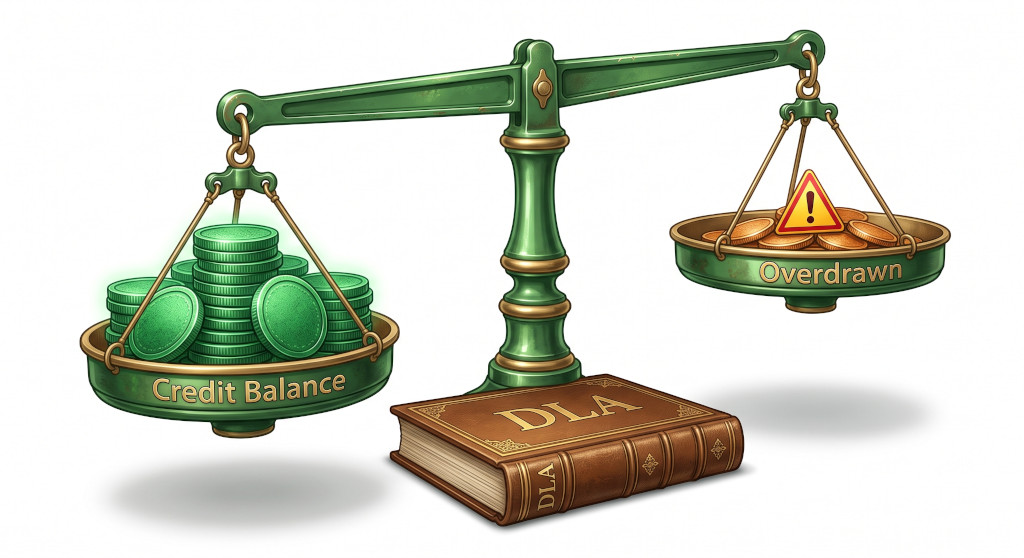
When your director’s loan account has a credit balance, the company owes you money. This typically happens when you’ve injected funds, paid company costs personally, or haven’t yet drawn all the salary the company has put through payroll. A credit balance is benign — you can withdraw it at any time and the repayment is not taxable, because it’s simply the company returning funds that were always yours.
An overdrawn director’s loan account is the opposite: you’ve taken more out of the company than you’ve put in (or been formally paid), meaning you now owe the company money. This is where the tax rules kick in.
An overdrawn director’s loan account is, in legal terms, money owed by the director to the company — a genuine debt that must be treated as such. If the company were to enter insolvency with the DLA still overdrawn, the liquidator could pursue the director personally for repayment.
How a Director’s Loan Account Is Recorded
The DLA is a balance sheet account. It appears under either current assets (if overdrawn — the company is owed money, so it is an asset from the company’s perspective) or current liabilities (if in credit — the company owes the director, so it is a liability). The double-entry for common DLA movements is straightforward:
| Transaction | Debit | Credit |
|---|---|---|
| Director takes cash from company bank account | Director’s Loan Account (asset) | Bank |
| Director pays company expense personally | Expense account (e.g. Travel) | Director’s Loan Account (liability) |
| Director repays the company | Bank | Director’s Loan Account (asset) |
| Director lends money to company | Bank | Director’s Loan Account (liability) |
Most accounting software handles DLA movements through a dedicated nominal code. The key discipline is ensuring every personal/company money movement is recorded promptly — a DLA that is reconciled quarterly rather than continuously quickly becomes a guessing game at year-end.
The S455 Tax Charge on Overdrawn DLAs
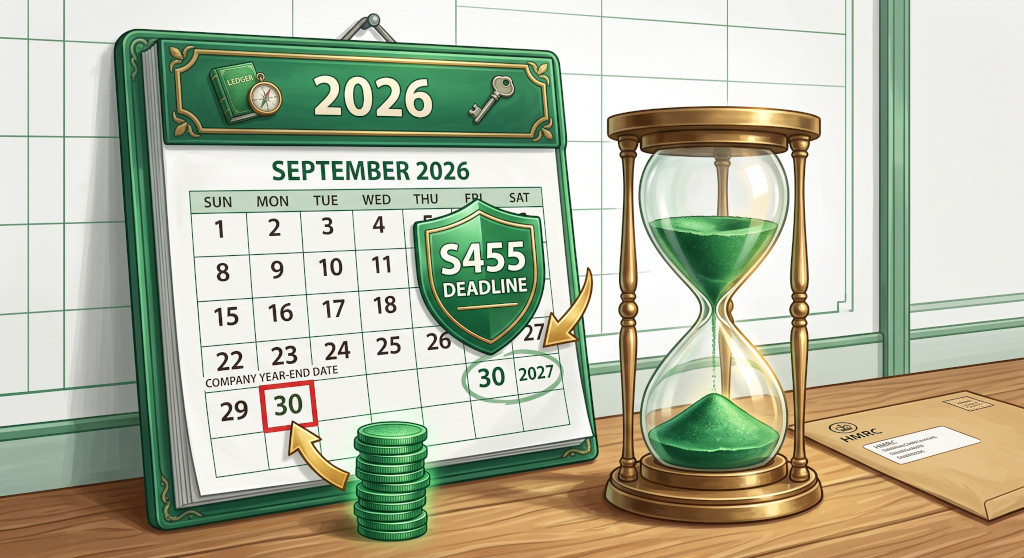
If your director’s loan account is overdrawn at your company’s year-end and has not been repaid within nine months of that year-end, HMRC charges the company a tax called the Section 455 (S455) charge — currently set at 33.75% of the outstanding overdrawn balance (matching the higher dividend tax rate).
Here is how the timeline works for a company with a 31 March year-end:
| Event | Date |
|---|---|
| Company year-end | 31 March 2026 |
| Nine-month repayment deadline | 31 December 2026 |
| Corporation tax payment due (incl. S455 if applicable) | 31 December 2026 |
If the overdrawn balance is repaid in full before the nine-month deadline, no S455 tax is payable. If the loan is repaid after the company has paid S455, HMRC will refund the S455 charge — but this refund does not arrive until nine months after the end of the accounting period in which the loan was repaid. The S455 charge is therefore effectively a temporary tax on cash the director has borrowed — but one that can become permanent if the loan is never repaid.
Important: a director cannot avoid S455 by simply repaying the overdrawn loan and then immediately borrowing the same amount again. HMRC has anti-avoidance rules (sometimes called the “bed and breakfasting” rules) that apply where loans of £5,000 or more are repaid and re-drawn within 30 days.
Benefit in Kind: Interest-Free Loans Over £10,000
A second tax complication arises if the overdrawn director’s loan account exceeds £10,000 at any point during the tax year. HMRC treats an interest-free or low-interest loan above this threshold as a benefit in kind — a taxable non-cash benefit received by the director as an employee.
The taxable benefit is calculated as the difference between the interest actually charged by the company (often zero) and the HMRC “official rate of interest” applied to the average loan balance for the year. This benefit must be reported on a P11D form and is subject to:
- Income tax on the director personally, at their marginal rate
- Class 1A National Insurance on the company, at 13.8% of the benefit value
The simplest way to avoid a benefit-in-kind liability is to charge the director interest at or above the HMRC official rate — though this interest income then becomes taxable in the company’s hands, so the practical benefit of doing so is limited.
How to Manage Your Director’s Loan Account
A well-managed DLA is straightforward. Problems arise when directors treat the company bank account as a personal account without tracking the movements. A few practical rules help:
- Record every movement immediately. Don’t leave DLA entries to be reconciled at year-end. If you take £500 for a personal purchase, record it the same day.
- Set a repayment plan if overdrawn. If the DLA is overdrawn at year-end, confirm whether it can be repaid within nine months before S455 bites — or make a conscious decision to pay the S455 charge as a borrowing cost.
- Consider paying a dividend instead. If you need to extract cash from the company, a properly declared dividend is usually more tax-efficient than an overdrawn loan, provided there are sufficient distributable profits.
- Keep it below £10,000. If your overdrawn balance stays below £10,000 throughout the year, you avoid the benefit-in-kind complication entirely.
- Document any loans from you to the company. If you inject personal funds, record this formally — a simple signed loan agreement protects you if the company’s solvency ever comes into question.
Director’s Loan Accounts in the Statutory Accounts
UK company law requires that any loan from the company to a director be disclosed in the notes to the statutory accounts. This applies whether the loan is overdrawn at year-end or was overdrawn during the year and repaid before year-end. The disclosure includes the loan amount, any interest charged, the maximum balance outstanding during the year, and whether it has been repaid. This is a legal requirement under the Companies Act 2006, and failure to disclose can make the accounts defective.
Key Takeaways
- A director’s loan account records all money flows between a director and their limited company that are not salary, dividends, or documented expense reimbursements.
- A credit DLA means the company owes you — you can withdraw this tax-free. An overdrawn DLA means you owe the company — this triggers tax risks.
- If the overdrawn DLA is not repaid within nine months of the company year-end, HMRC charges S455 tax at 33.75% of the outstanding balance.
- Overdrawn loans exceeding £10,000 at any point in the tax year create a benefit-in-kind liability, reportable on a P11D with income tax and Class 1A NI consequences.
- Anti-avoidance rules prevent directors from repaying and immediately re-borrowing to reset the nine-month clock on loans of £5,000 or more.
- Any loans from the company to a director must be disclosed in the statutory accounts, regardless of whether they are repaid before year-end.