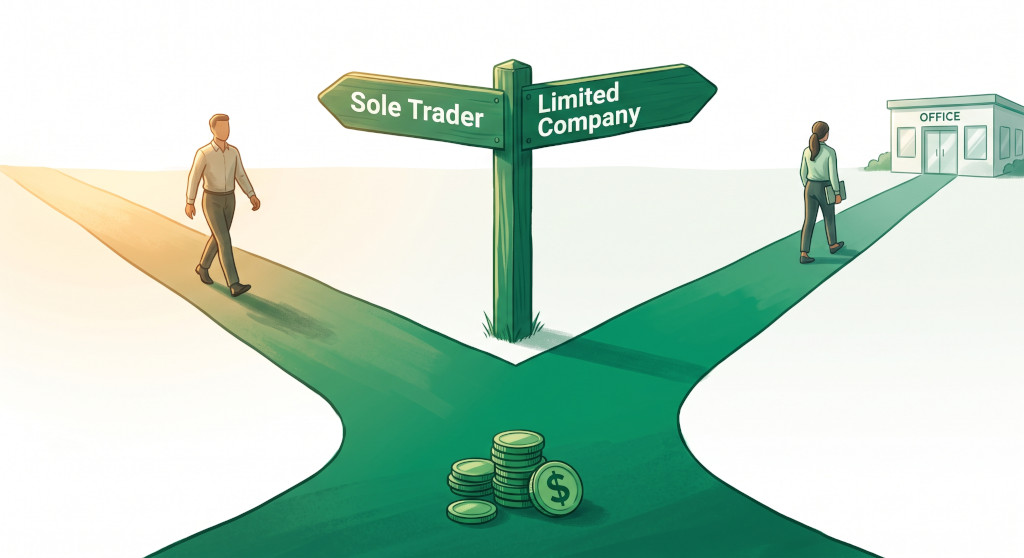
One of the earliest and most consequential decisions any business owner makes is also one of the least understood: should you operate as a sole trader or set up a limited company? For many people, the choice is made by default — they start trading as a sole trader because it is simpler, and never revisit the question. For others, it is made on gut instinct or advice from someone who registered a company for entirely different reasons. In reality, the two structures have fundamentally different accounting obligations, tax treatments, and levels of personal financial risk. Understanding those differences — concretely, not in the abstract — is the starting point for making the right choice for your business at its current stage.
The Fundamental Difference: Separate Legal Identity
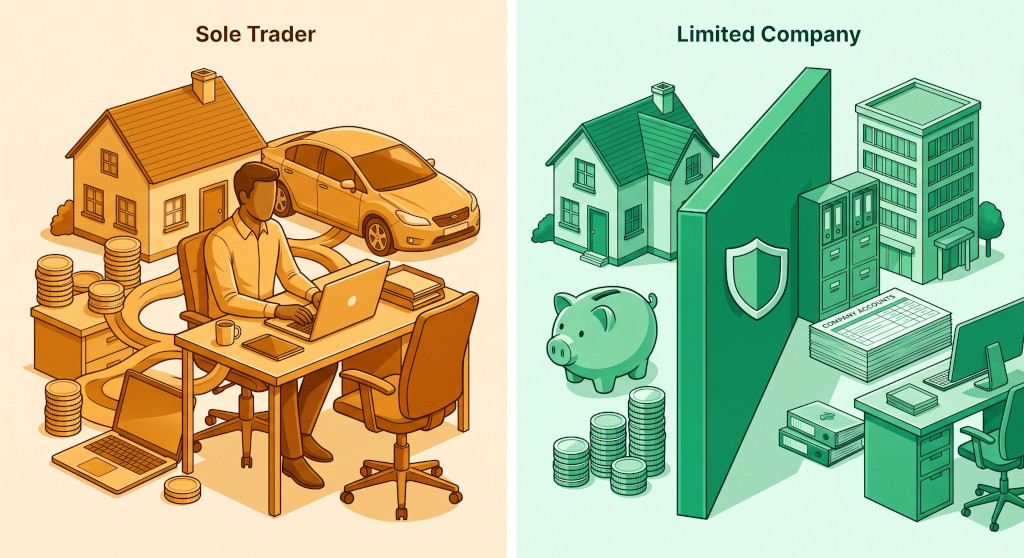
The most important distinction between a sole trader and a limited company is not tax — it is legal identity. A limited company is a separate legal entity from its owner. It can own assets, enter contracts, take on debt, and be sued in its own name. Its finances are, in law, entirely separate from the personal finances of its directors and shareholders.
A sole trader has no such separation. In law, the business and the individual are the same entity. There is no corporate veil. If your sole trader business runs into debt — a supplier you cannot pay, a contract you cannot fulfil, a legal claim against you — your personal assets are on the line. Your home, your savings, your car. This is called unlimited liability, and it is the defining risk of operating as a sole trader.
A limited company provides limited liability: shareholders can lose the value of their shares and any personal guarantees they have given, but their personal assets are generally protected. This does not mean a limited company is without risk — directors frequently give personal guarantees on business loans — but the default position is one of protection that a sole trader does not have.
Accounting Records and Reporting Obligations
The accounting requirements for the two structures differ significantly, and this is one of the practical realities that solo business owners often underestimate when considering incorporation.
Sole Trader
A sole trader must keep records of their business income and expenses and complete a Self Assessment tax return each year. There is no requirement to prepare formal accounts in any prescribed format — a simple spreadsheet recording income and allowable expenses is sufficient for tax purposes, though good bookkeeping practices are always advisable. There are no public filing requirements: a sole trader’s financial information remains entirely private.
Limited Company
A limited company has significantly more formal obligations:
- It must maintain proper statutory accounts prepared under UK GAAP or applicable accounting standards.
- These accounts must be filed with Companies House each year — and are publicly available for anyone to view.
- A Corporation Tax return (CT600) must be filed with HMRC.
- Directors who receive a salary must be registered under PAYE.
- A Confirmation Statement must be filed with Companies House annually confirming the company’s details.
This additional administration is one of the main reasons some business owners prefer to remain sole traders, particularly in the early stages or at lower income levels. Most limited company owners work with an accountant to manage these obligations, which adds to the ongoing cost of the structure.
The accounting burden of a limited company is real — but so is the cost of getting it wrong as a sole trader. Unlimited liability means that inadequate insurance, a contract dispute, or an unexpected tax bill can have consequences that go well beyond the business. The “simpler” structure is not always the safer one.
Tax Treatment: Where the Real Differences Lie
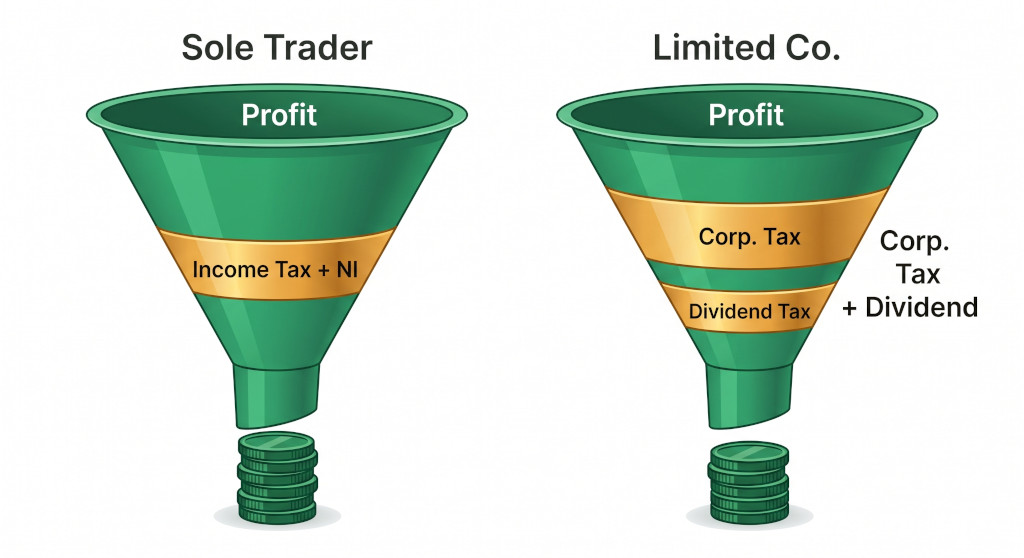
Tax is where the financial calculus between the two structures becomes most significant — and most nuanced. The right answer depends on your profit level, how much you draw from the business, and your wider personal tax position.
Sole Trader Taxation
A sole trader pays Income Tax and National Insurance Contributions (NICs) on their business profits — not on what they draw from the business, but on the profit itself. If the business makes £80,000 in profit and the owner only draws £40,000, they still pay tax on £80,000. Profits are added to any other personal income and taxed through Self Assessment at Income Tax rates (20%, 40%, 45% depending on the band) plus Class 4 NICs.
Limited Company Taxation
A limited company pays Corporation Tax on its profits (currently 25% for profits above £250,000, with a lower small profits rate of 19% for profits under £50,000, and marginal relief in between — rates correct as of 2026, check HMRC for current rates). The company’s after-tax profit can then be distributed to shareholders as dividends, which are taxed at lower rates than salary (8.75% basic rate, 33.75% higher rate, 39.35% additional rate) and benefit from the annual dividend allowance.
Most owner-managers of limited companies structure their remuneration as a combination of a small salary (up to the National Insurance threshold, to accrue NI credits without incurring NICs) and dividends for the remainder. This can result in a meaningfully lower overall tax and NI burden compared with operating as a sole trader at the same profit level.
Comparison at a Glance
| Factor | Sole Trader | Limited Company |
|---|---|---|
| Tax on profits | Income Tax + NICs on all profit | Corporation Tax on company profit |
| Tax on drawings | N/A — profits taxed regardless of drawings | Salary taxed via PAYE; dividends at dividend rates |
| National Insurance | Class 2 + Class 4 NICs on profits | Employer + employee NICs on salary only |
| VAT registration | Required if turnover exceeds threshold | Required if turnover exceeds threshold |
| Tax return | Self Assessment (personal) | CT600 (company) + Self Assessment (director) |
| Retained profits | Taxed in the year earned | Can be retained in company at corporation tax rate |
| Liability | Unlimited | Limited (subject to guarantees) |
| Public filing | None — fully private | Annual accounts filed at Companies House (public) |
| Setup and admin cost | Very low | Higher — accountant typically required |
When Does Incorporating Make Financial Sense?
There is no universal threshold at which incorporation automatically becomes the right choice, but there are practical indicators worth considering.
Profit level. At lower profit levels — say, below £30,000–£40,000 — the tax savings from a limited company structure may not justify the additional administrative cost and accounting fees. As profits grow above £50,000–£60,000, the difference in tax treatment tends to become more significant, particularly because corporation tax is charged only on retained profits, not on everything the business earns.
Retained profits. One of the most underappreciated advantages of a limited company is the ability to leave money in the business. If you do not need to draw all of your profits personally in a given year, a limited company lets you pay corporation tax now and defer the personal tax until you extract the money. A sole trader has no such option — all profits are taxed in the year they arise, regardless of whether the money stays in the business.
Credibility and contracts. Some larger clients and public sector organisations prefer — or require — to contract with limited companies. If you work in professional services and are growing your client base, being incorporated can open doors that remain closed to sole traders.
Risk profile. If your work carries any meaningful professional liability — you are giving advice, delivering projects, handling client funds — the limited liability protection of a company is worth taking seriously. Combined with professional indemnity insurance, it provides a meaningful layer of protection.
Understanding the accounting that underlies your business finances is essential whichever structure you choose. A strong grasp of how your income statement works, how your profit is calculated, and what your expenses include will help you have more productive conversations with your accountant and make better decisions at every stage of growth. The post on understanding the income statement is a practical starting point for building that foundation.
Key Takeaways
- The most important difference between a sole trader and a limited company is legal identity: a limited company is a separate legal entity with limited liability; a sole trader has unlimited personal liability.
- A sole trader pays Income Tax and NICs on all business profits through Self Assessment; a limited company pays Corporation Tax, with directors typically extracting a mix of salary and dividends.
- Limited company structures typically offer tax efficiency advantages at higher profit levels — but the benefit must be weighed against higher accounting and administration costs.
- A limited company’s accounts are filed publicly at Companies House; a sole trader’s finances are entirely private.
- The ability to retain profits in a limited company at corporation tax rates — deferring personal tax — is a significant planning advantage that sole traders do not have.
- Incorporation is not always the right move: at lower profit levels, the tax saving may not offset the additional complexity and cost.
- Whatever structure you choose, good bookkeeping and a qualified accountant are not optional — they are the foundation of sound financial management.