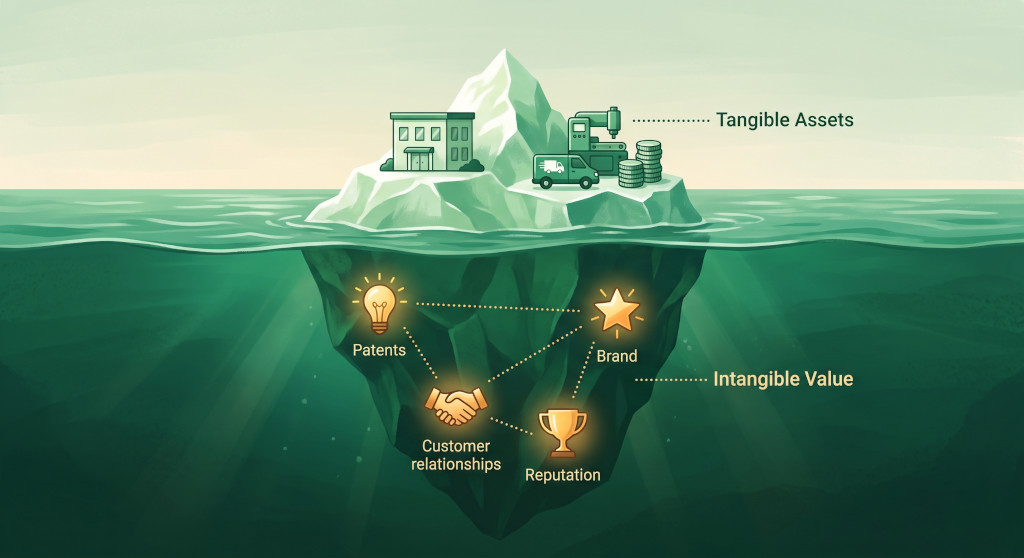
When a business sells for more than the value of everything you can see and touch, the difference has a name: goodwill. It captures the things that make a business worth more than the sum of its parts — a loyal customer base, a trusted brand, a skilled team, or a market position that took decades to build. Goodwill is just one type of intangible asset, but it’s the one that catches most business owners off guard when they encounter it for the first time on a balance sheet. This guide explains what intangible assets are, how goodwill arises, how both are recorded, and what happens to their value over time.
What Are Intangible Assets?

An intangible asset is an asset that has real economic value but no physical form. You can’t pick it up, store it in a warehouse, or put it on a shelf — but it can generate future revenues just as reliably as a machine or a property.
Common examples of intangible assets include:
- Patents and licences — legal rights to use or sell a protected invention or technology
- Trademarks and brand names — identifiable commercial identities that attract customers
- Customer lists and relationships — a documented, transferable base of paying clients
- Software — either developed in-house or purchased, where the rights are owned by the business
- Franchise agreements — the right to operate under an established brand and system
- Goodwill — the residual value paid in a business acquisition above the fair value of identifiable net assets
The key distinction accountants draw is between separately identifiable intangibles and goodwill. A patent can be sold on its own — it has a standalone value and a definable useful life. Goodwill, by contrast, cannot be separated from the business; it only exists in the context of an acquisition and cannot be sold independently.
What Is Goodwill and How Does It Arise?
Goodwill arises specifically when one company acquires another and pays more than the fair value of the acquired company’s identifiable net assets. It does not arise simply from running a successful business — under both UK GAAP (FRS 102) and international standards (IFRS 3), internally generated goodwill cannot be capitalised on the balance sheet, even if a business is clearly worth more than its book value.
The calculation is straightforward:
Goodwill = Purchase Price Paid − Fair Value of Net Identifiable Assets Acquired
Net identifiable assets = identifiable assets acquired − liabilities assumed
Here is a worked example to make this concrete.
| Item | Value |
|---|---|
| Purchase price paid | £500,000 |
| Fair value of property, plant & equipment | £280,000 |
| Fair value of customer contracts (identifiable intangible) | £60,000 |
| Inventories | £40,000 |
| Liabilities assumed | (£80,000) |
| Fair value of net identifiable assets | £300,000 |
| Goodwill (£500,000 − £300,000) | £200,000 |
The £200,000 goodwill figure represents what the buyer was willing to pay for the acquired business’s reputation, customer loyalty, market position, and other intangible qualities that don’t show up on the seller’s own balance sheet. It is recorded as a non-current intangible asset on the acquiring company’s balance sheet from the date of acquisition.
How Intangible Assets Appear on the Balance Sheet
Intangible assets sit within the non-current assets section of the balance sheet, above tangible fixed assets in many layouts. They are shown at cost, less any accumulated amortisation and impairment losses — mirroring exactly how tangible assets are shown at cost less accumulated depreciation.
A simplified intangibles section of a balance sheet might look like this:
| Intangible Assets | Cost | Accumulated Amortisation | Net Book Value |
|---|---|---|---|
| Goodwill | £200,000 | (£40,000) | £160,000 |
| Customer contracts | £60,000 | (£20,000) | £40,000 |
| Software licence | £15,000 | (£9,000) | £6,000 |
| Total intangible assets | £275,000 | (£69,000) | £206,000 |
For a business to capitalise an intangible asset on its balance sheet at all, it must meet strict recognition criteria: it must be identifiable, the business must control it, and future economic benefits must be expected to flow from it. If these conditions aren’t met — for example, an internally generated brand name or internally generated customer list — the expenditure is expensed in the period it is incurred.
Amortisation and Impairment — How the Value Reduces
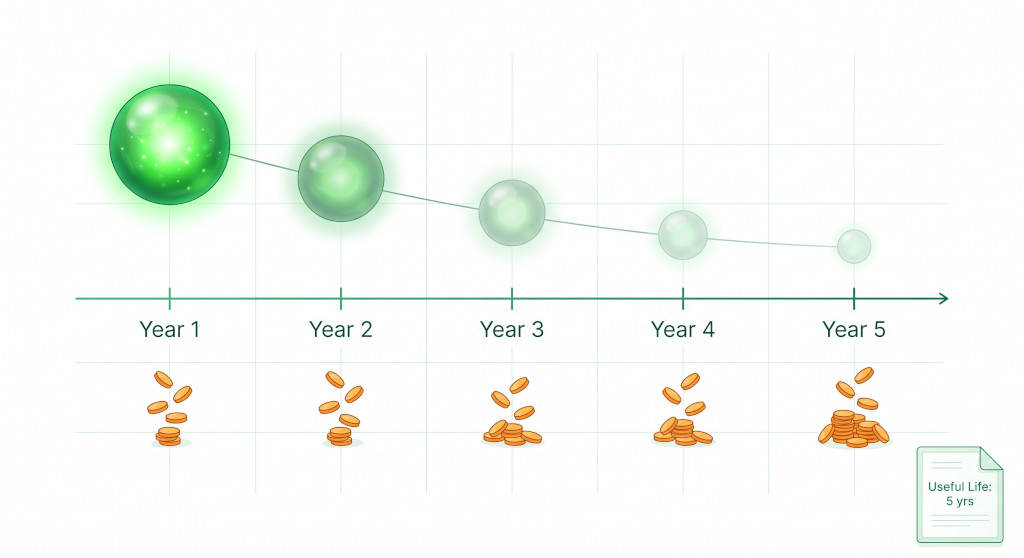
Just as tangible assets depreciate over time, intangible assets are typically amortised — their cost is written off systematically over their expected useful life.
Under FRS 102 (the standard most UK SMEs follow):
- Goodwill and intangibles must always be amortised over their useful economic life.
- If the useful life of goodwill cannot be reliably estimated, FRS 102 requires a maximum useful life of 10 years to be applied.
- The straight-line method is most common — divide the cost by the number of years.
Using the example above, if the £200,000 goodwill has an estimated useful life of 5 years:
- Annual amortisation charge: £200,000 ÷ 5 = £40,000 per year
- Journal entry each year: Dr Amortisation expense £40,000 / Cr Accumulated amortisation £40,000
- The amortisation charge hits the income statement each period, reducing profit.
Impairment is a separate concept. While amortisation is predictable and systematic, impairment is triggered when events suggest the asset’s carrying value may no longer be recoverable — for example, if the acquired business performs much worse than expected, or a key customer relationship breaks down. An impairment review compares the asset’s carrying amount to its recoverable amount, and if the recoverable amount is lower, the difference is written off immediately through the income statement.
Under IFRS (IAS 38 and IFRS 3), goodwill is not amortised at all — instead it is subject to a rigorous annual impairment test. For most UK SMEs reporting under FRS 102, however, regular amortisation applies and is far simpler to apply in practice.
Internally Generated vs Purchased Intangibles
One of the most common sources of confusion is why a business that has spent years building a powerful brand can’t recognise that brand on its own balance sheet, while a company that pays £2 million for that same brand in an acquisition can.
The answer lies in reliability and verifiability. When you buy something in an arm’s-length transaction, the purchase price gives you an objective, market-tested measure of fair value. When you build something internally, no transaction occurs — the cost is accumulated through many small decisions over many years, and there is no reliable way to separate the value of brand-building expenditure from the value of simply running the business day-to-day.
As a result, accounting standards prohibit the capitalisation of internally generated goodwill, brands, mastheads, customer lists, and similar items. The one exception under FRS 102 and IAS 38 is development costs — expenditure on applying research findings to create a new product or process can be capitalised once commercial viability is established, subject to meeting all six criteria set out in the standard (technical feasibility, intention to complete, ability to use or sell, probable future economic benefits, adequate resources, and ability to measure reliably).
Key Takeaways
- Intangible assets are assets with economic value but no physical form — patents, trademarks, customer lists, software, and goodwill.
- Goodwill arises only when acquiring another business; it is the premium paid above the fair value of net identifiable assets and cannot be separated or sold independently.
- Internally generated goodwill and most internally generated intangibles cannot be recognised on the balance sheet — only purchased intangibles qualify.
- Under FRS 102, both goodwill and intangibles must be amortised over their useful life; if the life of goodwill can’t be estimated, use a maximum of 10 years.
- Impairment is an additional write-down triggered when an asset’s carrying value exceeds its recoverable amount — separate from the systematic amortisation charge.
- Intangible assets appear on the balance sheet at cost less accumulated amortisation and impairment, mirroring the treatment of tangible fixed assets.