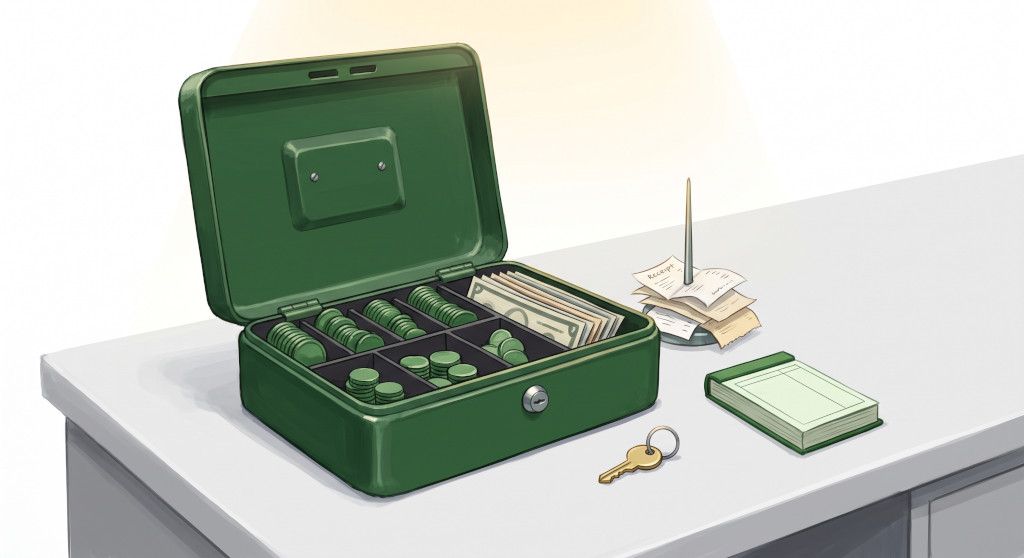
Petty cash is one of those accounting topics that sounds too simple to merit a guide — and yet it is responsible for a disproportionate share of bookkeeping errors, unexplained discrepancies, and, in the worst cases, small-scale fraud in small businesses. The principle is straightforward: keep a small amount of cash on hand for minor expenses that are impractical to pay by card or bank transfer. In practice, that simple idea requires a proper system — one with clear rules about who can access the cash, what it can be used for, how every transaction is documented, and how the float is reconciled. Get this right, and petty cash is a useful and manageable tool. Get it wrong, and it becomes a slow, invisible drain on your business.
What Is Petty Cash and Why Does It Exist?
Petty cash is a small fund of physical cash kept on-site by a business to cover minor, day-to-day expenses that cannot easily be paid through the main payment systems — things like a team member picking up stationery, paying for a courier, buying milk for the office, or covering a small taxi fare. These are legitimate business expenses, but processing each one through a formal purchase order or expense claim system is disproportionate to the value involved.
The petty cash fund is typically set up with a fixed amount — called the float or imprest — and topped back up to that level periodically as cash is spent. This is known as the imprest system, and it is the standard approach because it makes the fund predictable, auditable, and easy to reconcile: at any point in time, the cash remaining in the box plus the receipts for amounts spent should always equal the original float.
Most businesses set petty cash floats between £50 and £500, depending on the volume and typical size of small cash expenses. A float that is too small means constant top-ups; one that is too large increases the risk of loss or misuse.
How to Set Up a Petty Cash System
A functional petty cash system needs four things: a designated custodian, a physical cash box, a petty cash log or book, and a clear policy on what the cash can and cannot be used for.
Step 1: Appoint a petty cash custodian
One person should be responsible for the petty cash fund — typically an office manager, bookkeeper, or administrator. The custodian holds the key to the cash box, approves requests, ensures receipts are collected, and keeps the log up to date. Having a single point of responsibility is the most important control in any petty cash system. When everyone has access, no one is accountable.
Step 2: Establish the float amount
Decide how much cash the fund will hold at the start of each period. Write a cheque or make a bank transfer to “Petty Cash” for that amount. The journal entry in your accounting records is:
- Debit: Petty Cash (an asset account)
- Credit: Bank
This moves the money from your bank account into the petty cash account in your books, reflecting the physical cash now in the box.
Step 3: Create a written policy
Set clear rules about what petty cash can be used for and — equally important — what it cannot. Common permitted uses include office sundries, refreshments for meetings, minor postage, small cleaning supplies, and nominal travel reimbursements. Common restrictions: no use for personal expenses, no payments above a set limit (typically £20–£50 per transaction), and no cash-back or loans.
Step 4: Get the right supplies
A lockable cash box, a petty cash book or log (spreadsheet is fine), and a supply of petty cash vouchers are all you need. Many businesses use pre-printed vouchers that include fields for date, amount, purpose, expense category, and authorisation signature.
Recording Petty Cash Transactions

Every single payment from petty cash must be recorded at the time it is made. This is not bureaucracy — it is the only way to account for the cash accurately when you come to reconcile.
The process for each payment is:
- The person making the purchase collects a receipt and brings it back.
- The custodian issues a petty cash voucher (or stamps the receipt) and records the transaction in the petty cash log: date, amount, description, expense category.
- The receipt and voucher are stapled together and kept in the cash box alongside the remaining cash.
A well-maintained petty cash log might look like this:
| Date | Description | Category | Amount Out | Amount In | Balance |
|---|---|---|---|---|---|
| 1 Aug | Opening float | — | — | £200.00 | £200.00 |
| 3 Aug | Printer paper (A4, 2 reams) | Stationery | £14.50 | — | £185.50 |
| 7 Aug | Team meeting refreshments | Staff welfare | £22.80 | — | £162.70 |
| 12 Aug | Special delivery postage | Postage | £8.40 | — | £154.30 |
| 19 Aug | Taxi — client site visit | Travel | £17.00 | — | £137.30 |
| 21 Aug | Top-up to float | — | — | £62.70 | £200.00 |
When the custodian tops up the float, the accounting entry records each expense category and credits the bank. In the example above, the top-up of £62.70 would be recorded as:
- Debit: Stationery £14.50, Staff Welfare £22.80, Postage £8.40, Travel £17.00
- Credit: Bank £62.70
This is how petty cash expenditure enters your formal accounts — through the top-up entry, not at the point of individual spend. The petty cash account itself stays at £200 throughout (the float), which is how the imprest system works.
Petty Cash Controls — Preventing Misuse
Petty cash is a common target for minor fraud and casual misuse precisely because it feels informal. Strong controls do not require complexity; they require consistency.
The golden rule of petty cash: no receipt, no reimbursement. No exceptions. This single rule, enforced consistently, eliminates the majority of petty cash abuse.
Segregation of duties. Wherever possible, the person who authorises petty cash payments should not be the same person who performs the bank reconciliation or posts the accounting entries. In a very small business this may not be fully achievable, but even having a second person countersign large vouchers adds a meaningful control.
Surprise counts. Periodically — and without warning — a manager or business owner should count the cash in the box and compare it to the log balance. The cash plus receipts should always equal the float. If it does not, there is a discrepancy to investigate.
Spending limits. Set a maximum amount per transaction. Anything above the limit should go through the normal expense claim or purchase order process. This prevents the petty cash fund from being used to avoid proper procurement controls on larger purchases.
Regular reconciliation. Do not wait until the box is nearly empty to reconcile. Reconcile at least monthly — or more frequently if the fund is used heavily. The longer the gap between reconciliations, the harder it is to investigate any differences that emerge.
Reconciling Your Petty Cash Float
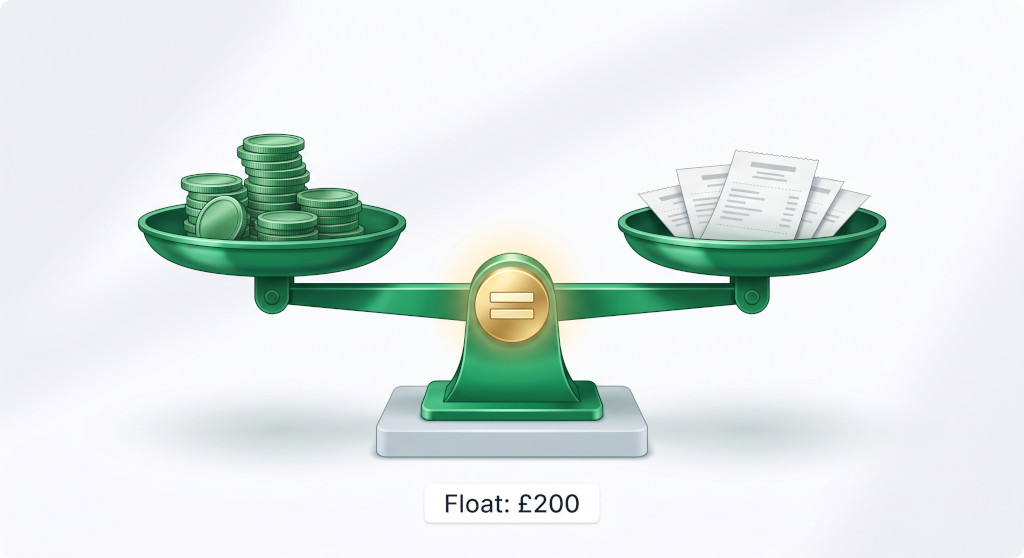
Reconciliation is the process of confirming that the physical cash in the box, plus all the recorded receipts and vouchers, adds up to the float amount. It is the same principle as a bank reconciliation but applied to physical cash.
The reconciliation equation is simple:
Cash in box + Total of receipts/vouchers = Opening float
If the totals do not agree, one of three things has happened: a receipt is missing, a transaction was recorded incorrectly, or cash has gone missing. Work through the log entry by entry, matching each voucher to its receipt, until you find the source of the difference. Document any discrepancies and the investigation steps taken — this is important for your audit trail.
When you top up the float, that is also a natural reconciliation point. The top-up amount should exactly equal the total of all vouchers since the last top-up. If it does not, you have a difference to resolve before the money leaves the bank account.
Petty cash sits within the broader framework of cash management and bookkeeping. If you want to understand how small cash transactions feed into your double-entry records more broadly, the guide to double-entry bookkeeping and journal entries explains the underlying mechanics in full. And for understanding how all your expense accounts are organised, the post on setting up a chart of accounts for your SME covers the structure behind the categories you use in your petty cash log.
Key Takeaways
- Petty cash is a small, fixed fund of physical cash kept on hand to cover minor business expenses that are impractical to pay through normal payment channels.
- The imprest system sets a fixed float amount; the fund is topped back up to that amount periodically, making reconciliation straightforward: cash remaining + receipts always = float.
- Appoint a single custodian with a key to the cash box — shared access with no accountability is the most common cause of petty cash problems.
- Every payment must be documented immediately with a receipt and a petty cash voucher; “no receipt, no reimbursement” is the most effective single control.
- Petty cash expenditure enters your formal accounts through the top-up journal entry, which records each expense category debited and the bank credited.
- Reconcile regularly — at least monthly — and investigate any discrepancy between cash in the box and the log balance before closing off the period.
- Surprise cash counts and spending limits are simple, effective controls that significantly reduce the risk of misuse.
Related Reading
- Double-Entry Bookkeeping Explained: How Journal Entries Keep Your Accounts in Balance
- Chart of Accounts for SMEs: How to Set One Up and Why It Matters
- Accounts Receivable and Accounts Payable Explained: A Practical Guide for SME Owners
- Accruals and Prepayments Explained: The Accounting Entries Every SME Owner Needs to Understand