If you have ever looked at a set of accounts and noticed entries for things like “accrued expenses” on the balance sheet or “prepayments” in the current assets section, you have encountered one of the most important — and most misunderstood — principles in accounting. Accruals and prepayments exist because of a fundamental rule: income and expenses must be recognised in the accounting period they belong to, not simply when money changes hands. For SME owners moving beyond basic bookkeeping, understanding this principle is the difference between accounts that tell you the truth about your business and accounts that give you a distorted picture of your profitability.
Why Timing Matters in Accounting: The Matching Principle
Most people think of money in terms of cash: you earn it when it lands in the bank and spend it when it leaves. But accrual accounting — the method required for most formal sets of accounts — operates on a different logic. It follows the matching principle: revenues and expenses should be matched to the period in which the underlying economic activity occurs, regardless of when the cash actually moves.
Consider a simple example. You pay your business insurance for the year in January: £2,400 in a single lump sum. Under cash accounting, that entire cost hits your January profit and loss statement. Under accrual accounting, £200 of insurance cost is recognised each month — because each month you are using one month’s worth of cover. The remaining unused portion sits on the balance sheet as a prepayment (an asset — money you have paid for something you haven’t yet received).
The matching principle produces accounts that reflect the economic reality of what happened during a period, rather than the happenstance of when payments were timed. It is why almost every business using formal accounts — whether to comply with company law, to present to a bank, or to get an accurate read on profitability — operates on an accruals basis.
The Four Types: Accruals and Prepayments Unpacked
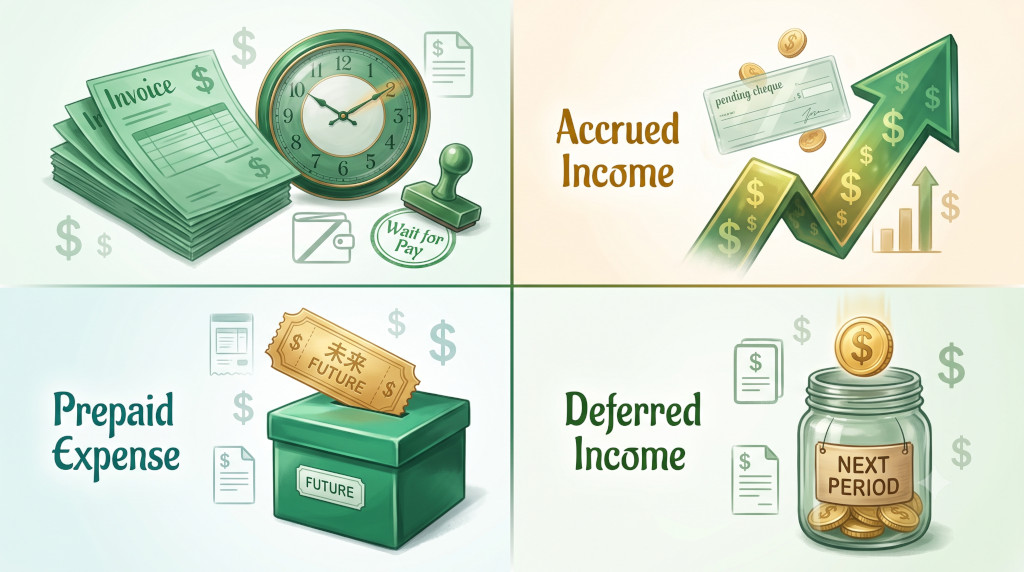
There are four distinct adjustments that fall under the accruals and prepayments umbrella. Two relate to expenses; two relate to income.
1. Accrued Expenses (Accruals)
An accrued expense is a cost you have incurred during the accounting period but have not yet paid or received an invoice for. The economic event has happened; the cash has not moved yet.
Common examples include electricity and gas bills that run to the end of the month but arrive several weeks later, wages for the final few days of a month that are paid in the following month, or professional fees for work completed but not yet invoiced. The cost belongs to the current period, so it must be recognised now — even without a payment or invoice to match.
In double-entry terms, you debit the relevant expense account (increasing the expense in your P&L) and credit an “accruals” or “accrued expenses” liability on the balance sheet. When the payment eventually arrives, you reverse the accrual entry and record the actual payment.
2. Prepaid Expenses (Prepayments)
A prepaid expense is the mirror image: you have paid for something in advance that covers a future period. Part of the payment belongs to the current period; the remainder belongs to one or more future periods.
Insurance paid annually, software subscriptions paid quarterly, and rent paid in advance are all classic prepayments. The portion relating to the current period is expensed through the P&L; the unused portion is held on the balance sheet as a current asset — money owed to you in the form of future economic benefit.
3. Accrued Income
Accrued income arises when you have earned revenue during the period but have not yet issued an invoice or received payment. You have delivered the service or supplied the goods; the income belongs to this period. A consultant who completes a project in December but invoices in January must still recognise the income in December under the accruals basis.
The accounting entry records the income in the P&L and carries a corresponding debtor (receivable) on the balance sheet — an amount owed to the business that has not yet been formally invoiced.
4. Deferred Income
Deferred income is the opposite: you have received cash from a customer for something you have not yet delivered or earned. A deposit taken for a job not yet started, or an annual subscription received upfront, creates deferred income. The cash is in the bank, but the income is not yours yet — you still have an obligation to perform.
On the balance sheet, deferred income sits as a liability. As you deliver the service or product over time, you recognise the income progressively through the P&L.
Key insight: Accruals and prepayments are timing adjustments — they ensure the right amount of income and expense lands in the right accounting period, regardless of when money moves. At the end of every period, these entries are reviewed and reversed or updated as appropriate.
How Accruals and Prepayments Appear in Your Financial Statements
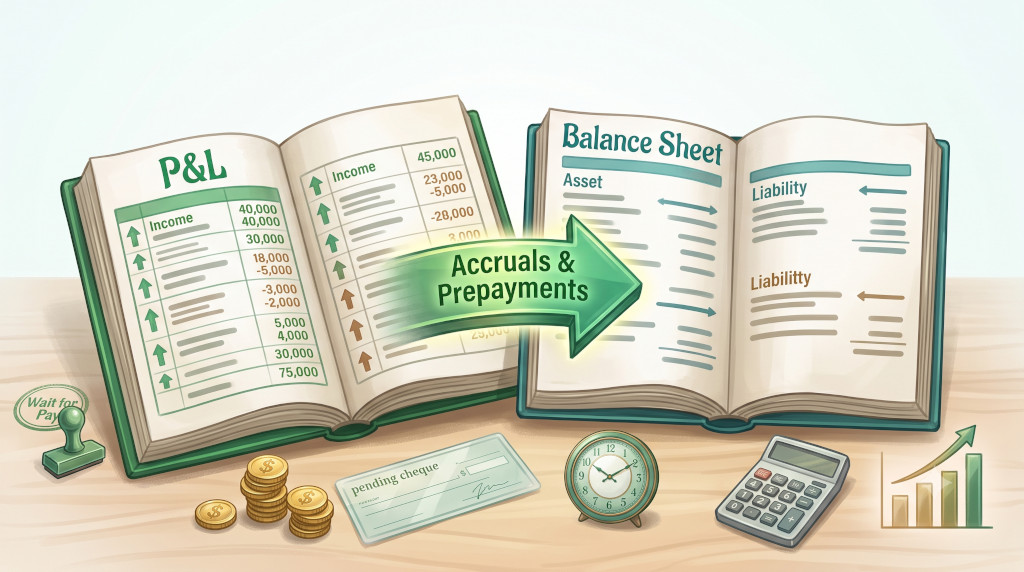
Once you understand the four types, it becomes straightforward to trace where they appear in a standard set of accounts.
| Entry Type | P&L Effect | Balance Sheet Effect |
|---|---|---|
| Accrued Expense | Increases expenses in the current period | Creates a liability (accruals / creditors) |
| Prepaid Expense | Reduces expense recognised in the current period | Creates a current asset (prepayments) |
| Accrued Income | Increases revenue in the current period | Creates a current asset (accrued income / debtors) |
| Deferred Income | Reduces revenue recognised in the current period | Creates a liability (deferred income) |
If your balance sheet shows a line for prepayments under current assets, it represents money you have already paid for goods or services that relate to a future period — an economic benefit the business will receive. If it shows accruals under current liabilities, it represents costs already incurred that have not yet been settled in cash.
A Worked Example: Hartley Studio
Hartley Studio is a small creative agency preparing accounts for the financial year ending 31 March 2026. As the year-end approaches, the bookkeeper identifies four timing adjustments needed:
| Situation | Type | P&L Adjustment | Balance Sheet |
|---|---|---|---|
| Electricity bill for March not yet received — estimated £340 | Accrued Expense | + £340 utilities expense | + £340 accruals (liability) |
| Annual software licence paid Jan 2026 — £1,200. 3 months remain after year-end. | Prepaid Expense | − £300 software expense (future months) | + £300 prepayments (asset) |
| Design project delivered in March — client invoice not yet raised — £2,500 | Accrued Income | + £2,500 revenue | + £2,500 accrued income (asset) |
| Deposit received in February for project starting April — £800 | Deferred Income | − £800 revenue (not yet earned) | + £800 deferred income (liability) |
Without these four adjustments, Hartley Studio’s year-end accounts would understate expenses by £340, overstate expenses by £300 (software charged entirely to this year), miss £2,500 of revenue earned but not yet invoiced, and include £800 of revenue not yet earned. The net distortion would render the profit figure unreliable.
Each of these adjustments is reversed at the start of the following period, and the actual transactions then replace them as they occur — a clean mechanism that keeps each period’s accounts accurate.
Why Accruals and Prepayments Matter for Your Business
For any SME preparing formal accounts — whether for Companies House, for a bank loan application, or simply for reliable management information — getting accruals and prepayments right is not optional. Here is why it matters in practice.
Accurate profitability. If large expenses routinely hit the P&L in the wrong month, your monthly profit figures are noise rather than signal. A business that pays an annual insurance premium in January will show an apparently unprofitable January and falsely profitable months for the rest of the year — making it impossible to track trends or spot problems.
Correct balance sheet values. Prepayments are genuine assets — cash you have committed that will generate future economic benefit. Accrued income is money you have genuinely earned. Omitting these distorts the balance sheet and can misrepresent the business’s financial position to lenders, investors or potential buyers.
Reliable management accounts. If you use monthly management accounts to run your business, accruals and prepayments are what make those accounts comparable month to month. Without them, you are looking at a cash flow statement dressed up as a P&L. You can read more about the role of management accounts in our guide to management accounts vs statutory accounts.
Audit readiness. Accruals are among the most scrutinised items in any audit. Poorly documented or missing accrual entries — particularly for material year-end expenses — are a common source of audit queries and adjustments. For businesses that consolidate across multiple entities, ensuring consistent accrual treatment across all subsidiaries is an additional layer of complexity; BrizoConsol’s guide on preparing for audit with consolidated financials covers how groups manage this at the reporting level.
Tax implications. In most jurisdictions, taxable profit is calculated on an accruals basis. Misclassifying or omitting accruals can therefore affect the tax you report, potentially creating under- or over-payment that the tax authority may later challenge.
Key Takeaways
- Accruals and prepayments are timing adjustments that ensure income and expenses are recognised in the accounting period they belong to — not simply when cash moves. This is called the matching principle.
- There are four types: accrued expenses (costs incurred but not yet paid), prepaid expenses (costs paid in advance for future periods), accrued income (revenue earned but not yet invoiced), and deferred income (cash received for services not yet delivered).
- Accruals and prepayments create entries on both the P&L and the balance sheet: liabilities for costs owed or income received early, and assets for payments made in advance or income earned but not yet received.
- Without these adjustments, monthly and annual accounts will misrepresent profitability, distort the balance sheet, and make period-to-period comparisons unreliable.
- All accrual and prepayment entries are reversed at the start of the following period, and replaced by the actual transactions as they occur.
- Accruals are among the most closely reviewed items in a year-end audit — accurate, well-documented entries significantly reduce the chance of adjustments.
Related Reading
Accruals and prepayments connect directly to how your financial statements are constructed and how your business records transactions. These ARD guides provide the essential context:
- Double-Entry Bookkeeping Explained: How Journal Entries Keep Your Accounts in Balance — the double-entry mechanics behind every accrual and prepayment entry.
- Understanding the Income Statement: A Complete Guide to Profit & Loss for SMEs — how accruals and prepayments shape the revenue and expense lines you see in the P&L.
- Accounting Basics: The Balance Sheet: Structure and Key Elements — where prepayments (current assets) and accruals (current liabilities) appear on the balance sheet.
- Management Accounts vs Statutory Accounts: What’s the Difference and Why It Matters — how accruals underpin the reliability of both management and statutory reporting.