
Every year, thousands of profitable UK small and medium-sized businesses run into serious cash trouble — sometimes even insolvency — despite their accounts showing a healthy profit. If you have ever looked at your management accounts, seen a strong profit figure, and then wondered why your bank balance tells a completely different story, you are not alone. This is one of the most common and most damaging misunderstandings in business finance. The fix is not complicated once you understand one concept: free cash flow. This article explains what it is, why it differs from profit, and walks through a full worked example using a fictional joinery business so you can see exactly where the money goes.
Why ‘Profitable’ Businesses Run Out of Cash
Profit is an accounting measure. It follows the accruals concept, which means income and expenses are recorded when they are earned or incurred, not when cash actually moves in or out of your bank account. So if you invoice a customer £40,000 today, that appears as revenue and profit straight away — even if the customer does not pay you for sixty or ninety days. Meanwhile, you might have already paid your suppliers, your staff, and your VAT bill in cash. The result: healthy profit on paper, empty bank account in reality. Growing businesses are especially exposed to this, because growth usually means more stock, more debtors, and more upfront spending before the cash catches up.
What Free Cash Flow Actually Means
Free cash flow (often shortened to FCF) is simply the cash a business generates from its normal operations, after paying for the things it needs to keep running and growing — mainly working capital changes (stock, debtors, creditors) and capital expenditure (equipment, vehicles, machinery). It answers a very practical question: after everything the business genuinely had to spend cash on this year, how much cash is actually left over for the owner, for debt repayment, or for reinvestment? It is not a number that appears automatically on your profit and loss account. You have to build it, starting from profit and adjusting for the items that move cash differently from profit.
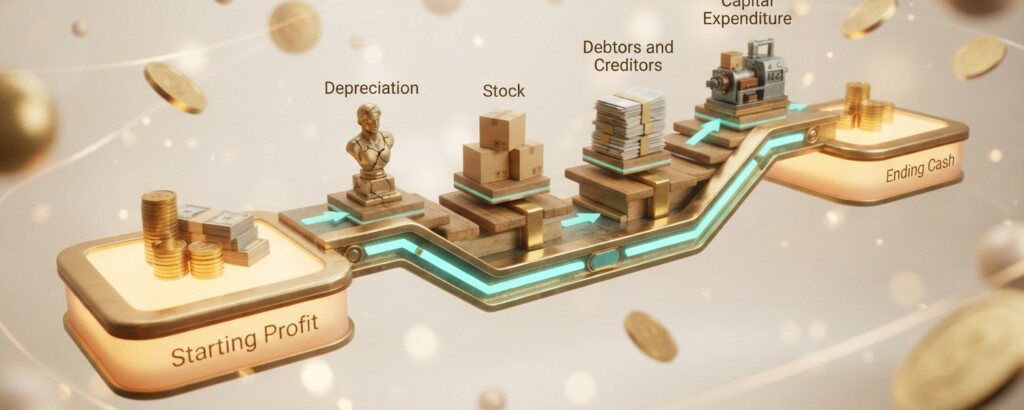
A Worked Example: Meet Riverside Joinery Ltd
Riverside Joinery Ltd makes bespoke kitchens and had a strong year of growth. Turnover rose sharply, new machinery was purchased to keep up with demand, and the directors were pleased to see a healthy profit after tax. Let us look at the year-end figures, then trace exactly what happened to the cash.
| Line | Amount (£) |
|---|---|
| Revenue | 850,000 |
| Cost of sales | (510,000) |
| Gross profit | 340,000 |
| Overheads | (220,000) |
| Operating profit | 120,000 |
| Finance costs | (5,000) |
| Profit before tax | 115,000 |
| Corporation tax | (21,850) |
| Profit after tax | 93,150 |
On the face of it, Riverside had a very good year: £93,150 of profit after tax, on turnover of £850,000. But during the year, the business also built up more stock to service larger orders, waited longer for customers to pay, and bought a new spindle moulder machine for the workshop. None of that shows up directly in the profit and loss account above — it shows up in the balance sheet, and it eats into cash. This is where the free cash flow calculation earns its keep.
| Profit after tax | 93,150 |
| Add back depreciation (non-cash expense) | 25,000 |
| Increase in stock (cash tied up in materials) | (60,000) |
| Increase in debtors (customers taking longer to pay) | (45,000) |
| Increase in creditors (suppliers giving longer terms) | 30,000 |
| Operating cash flow | 43,150 |
| Capital expenditure — new spindle moulder machine | (40,000) |
| Free cash flow | 3,150 |
That is the crux of it. Riverside made £93,150 of profit, but generated only £3,150 of genuinely free cash for the whole year. Depreciation is added back because it reduced profit but never involved any cash leaving the business — the cash for the machine went out separately, as capital expenditure, further down the calculation. The increases in stock and debtors are the real culprits here: £105,000 of cash is sitting in unsold materials and unpaid invoices rather than in the bank.
Reading the Numbers: What Happened to the Cash?
To make this tangible, consider a single transaction that contributed to the debtor increase. In March, Riverside completed a large kitchen installation and issued an invoice for £36,000 plus VAT, with 60-day payment terms. Under the accruals concept — the basis used in both UK GAAP (FRS 102) and IFRS — the revenue is recognised immediately, because the work has been completed and the right to payment exists, regardless of when the cash actually arrives.
| Account | Dr | Cr |
|---|---|---|
| Trade debtors | £43,200 | |
| Sales revenue | £36,000 | |
| VAT output tax | £7,200 |
Invoice raised on completion of kitchen installation, 60-day credit terms. Revenue and VAT are recognised immediately for accounting and tax purposes, but no cash has yet been received — this is exactly why profit can rise while the bank balance does not move at all.
Profit tells you whether the business model works. Free cash flow tells you whether the business can survive, pay its bills, and fund its own growth without constantly relying on the overdraft or new borrowing. Lenders, in particular, care far more about the second question than the first.

A common and costly mistake among SME directors is to base dividend or drawings decisions on the profit figure alone. Riverside’s directors, seeing £93,150 of after-tax profit, drew £50,000 in dividends during the year — reasonable-looking on paper, but the business only generated £3,150 of free cash flow. The shortfall had to be funded through the overdraft, increasing both interest costs and financial risk. Always check free cash flow, not just profit, before agreeing dividends, bonuses, or large owner drawings.
It is also worth noting that this pattern is not a sign that Riverside is badly run — quite the opposite. Growing businesses very often absorb cash into stock and debtors as they expand, because bigger orders mean more materials on the shelf and larger invoices outstanding at any one time. The issue only becomes dangerous when owners are not aware it is happening and make cash commitments — dividends, loan repayments, new hires, further capital purchases — as though the profit figure were sitting in the bank account waiting to be spent.
For finance managers preparing management reports, this is precisely why a simple free cash flow reconciliation, alongside the profit and loss account and balance sheet, should be standard monthly or quarterly reading for the board — not an annual afterthought buried in the statutory accounts. Under UK GAAP, a statement of cash flows is only mandatory for medium-sized and large companies (small and micro entities are exempt under Section 1A and FRS 105), but there is nothing stopping any SME from building a simplified version internally for management purposes, and every SME arguably should.
- Build a simple free cash flow reconciliation every quarter — start with profit, add back depreciation, then adjust for the change in stock, debtors and creditors, and finally deduct capital expenditure — so you see the real cash position, not just the accounting one.
- Track debtor days and stock turnover as closely as you track profit margin; a growing gap between profit and cash is almost always visible first in these two numbers.
- Base dividend, bonus and drawings decisions on free cash flow, not on profit after tax alone, to avoid relying on overdraft or short-term borrowing to fund distributions the business has not actually earned in cash.
- Before committing to significant capital expenditure or new borrowing, model the impact on free cash flow specifically, since profit forecasts alone can make a plan look far more affordable than it will actually feel in the bank.
Turn your numbers into decisions you can trust
If your management reports show profit but you are still unsure where the cash is going, we can help you build clear, jargon-free reporting — including cash flow — that gives you and your team a true picture of the business.