
A client once asked us why their balance sheet showed their warehouse at £300,000 when the estate agent next door had just valued it at £650,000 for a remortgage. They weren’t being misled — their accounts were entirely correct. But if you’re using the balance sheet to judge what your business is worth, to negotiate a sale, or to reassure a lender, that gap between the number on the page and the number in the market can cause real confusion, and sometimes real financial decisions get made on the wrong basis. This article explains why that gap exists, what it means for your business, and when you need to look beyond the balance sheet to find out what your assets are genuinely worth today.
What Historical Cost Actually Means
Historical cost is the default basis for most UK company accounts. It simply means an asset is recorded at what you paid for it, not what it might fetch if you sold it today. Once that figure is on the books, it only moves in predictable, rule-based ways — mainly through depreciation, which spreads the original cost over the asset’s useful life, and through impairment, which reduces the value if something has gone badly wrong (for example, a piece of machinery that’s been damaged or made obsolete). What historical cost does not do is track the market. If property prices rise, if a vintage delivery van becomes a collector’s item, or if your freehold warehouse doubles in value because a new transport link opens nearby, none of that filters through to the balance sheet under the cost model.
What Fair Value Means
Fair value is the alternative approach: it means stating an asset at what it would realistically sell for between knowledgeable, willing parties in an arm’s length transaction in an open market. Some items are required to be shown at fair value — certain financial instruments, for instance, or investment property under FRS 102 Section 16. Other items are only shown at fair value if a company chooses to adopt the revaluation model, which is permitted for classes of property, plant, and equipment (such as land and buildings) under both FRS 102 (Section 17) and IFRS (IAS 16). The key point for an SME owner is this: fair value is not a single universal rule that applies to everything you own. It applies selectively, depending on the asset type and the accounting policy your business has chosen. That’s precisely why two companies that own identical buildings can show wildly different numbers on their balance sheets, both completely compliant with the rules.
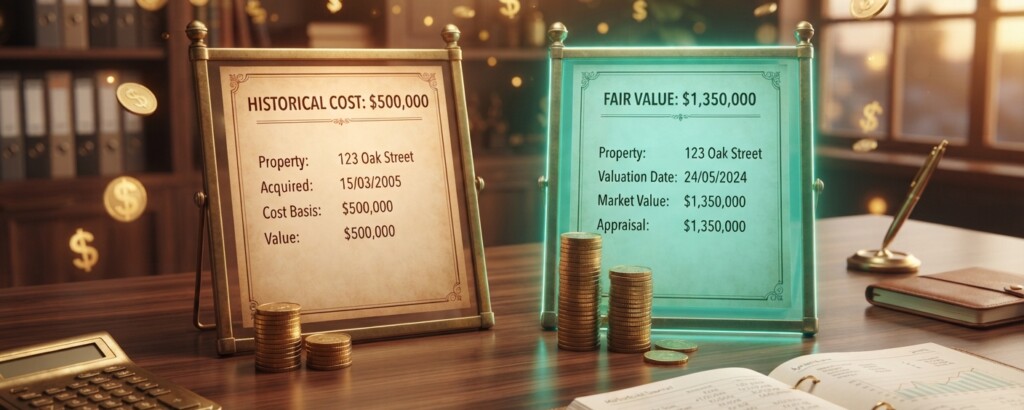
The balance sheet is not a valuation report. It’s a record of transactions, adjusted by accounting rules. For most SMEs using the cost model, long-held property and equipment are quietly understated, while recently purchased assets are usually close to current market value.
A Worked Example: The Warehouse Purchase
Let’s go back to the warehouse. Say your company bought a freehold warehouse in 2015 for £400,000, with no land element separated out for simplicity, and you depreciate it on a straight-line basis over 40 years with no residual value. Under the historical cost model, here’s what happens to the figure on your balance sheet over time, compared with what an estate agent might actually tell you it’s worth.
| Account | Dr | Cr |
|---|---|---|
| Freehold property (fixed asset) | £400,000 | |
| Bank | £400,000 |
Initial purchase of the warehouse in 2015, recorded at cost — this is the opening figure under the historical cost model.
| Original purchase price (2015) | £400,000 |
| Useful life assumed | 40 years |
| Annual straight-line depreciation (£400,000 ÷ 40) | £10,000 |
| Accumulated depreciation after 10 years | £100,000 |
| Net book value at 2025 (cost model) | £300,000 |
| Year | Historical cost — net book value | Estimated open-market fair value |
|---|---|---|
| 2015 (purchase) | £400,000 | £400,000 |
| 2020 (5 years on) | £350,000 | £500,000 |
| 2025 (10 years on) | £300,000 | £650,000 |
Notice what’s happening in each column separately. The historical cost column is mechanical — it simply falls by £10,000 a year because that’s what the depreciation policy says, regardless of what’s happening in the property market. The fair value column, by contrast, reflects supply, demand, location and condition — and in this case, the property market has moved in the owner’s favour. If this business wanted to switch to the revaluation model in 2025, the accounting entry would look like this.
| Account | Dr | Cr |
|---|---|---|
| Freehold property (fixed asset) | £350,000 | |
| Revaluation reserve (equity) | £350,000 |
Uplift from net book value of £300,000 to fair value of £650,000, recognised in other comprehensive income and accumulated in equity within the revaluation reserve rather than through profit or loss, as required under the revaluation model.
A revaluation gain is not cash and is not distributable profit. It sits in a revaluation reserve within equity, not retained earnings, and it cannot be paid out as a dividend. Owners sometimes assume a higher balance sheet value means more money available to extract from the business — it does not. It also typically increases future depreciation charges, since depreciation is then based on the new, higher value.

Where This Distinction Actually Matters for Your Business
For most day-to-day purposes, historical cost is simpler, cheaper to maintain, and less open to dispute, which is exactly why the majority of UK SMEs stick with it. But there are specific situations where relying on historical cost figures alone can lead you astray, and it helps to know when to stop and get a proper valuation instead of reading the number off the balance sheet.
- Selling the business or negotiating with a buyer — buyers value based on current worth and earning potential, not depreciated cost, so your balance sheet understates the asking price you should be discussing.
- Securing lending against property or equipment — lenders will almost always commission their own valuation rather than relying on your net book value, but you should expect the figures to differ and not be surprised.
- Insuring buildings and equipment — insuring at net book value risks serious under-insurance if reinstatement or rebuild costs have risen well above the depreciated figure on your books.
- Preparing consolidated group accounts where subsidiaries hold property acquired at very different times — mixing cost-model entities together can distort group-level asset figures if not adjusted consistently.
- Investment property held by the business — under FRS 102 Section 16, investment property is generally held at fair value through profit or loss, not depreciated cost, so the rules are different from your trading premises.
Key Takeaways
- Check which accounting policy your business uses for property and equipment — cost model or revaluation model — because it changes what the balance sheet is telling you and how often it’s updated.
- Never use net book value as a stand-in for market value when selling the business, remortgaging, or arranging insurance; get an independent valuation instead.
- If you revalue an asset upward, remember the gain sits in a revaluation reserve, it is not distributable, and it will usually increase future depreciation charges.
- When reviewing group accounts or comparing businesses, ask when each major asset was acquired — two balance sheets can look similar but represent very different real-world values.
Want your accounts to reflect what your business is actually worth?
We help SME owners and finance teams understand the numbers behind their balance sheet, choose the right accounting policies, and know when it’s time to get a proper valuation rather than relying on historical cost alone.