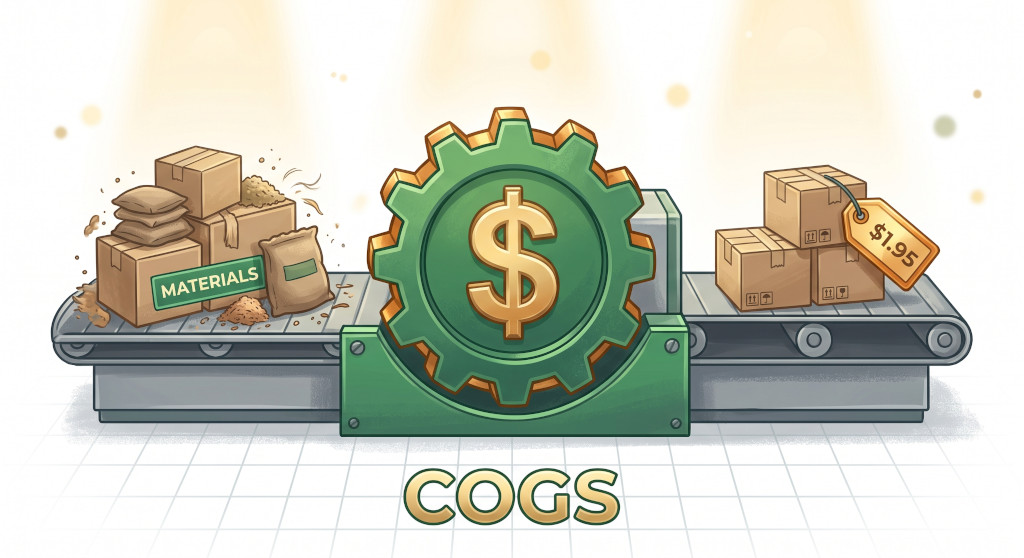
If your business makes or buys products to sell, there is one number that sits at the very heart of your profitability: the cost of goods sold. It is the total of everything it actually costs you to produce or acquire the products you sold during a given period. Get this figure right, and your gross profit makes sense. Get it wrong — through sloppy inventory tracking, misclassified expenses, or inconsistent costing methods — and every financial decision you make downstream is built on shaky ground. Understanding cost of goods sold is not optional for any business that sells physical products; it is foundational.
What Is Cost of Goods Sold?
Cost of goods sold — almost universally abbreviated to COGS — is the direct cost of producing or purchasing the goods that your business sold during a specific accounting period. It appears on your income statement, sitting directly below revenue, and the gap between the two is your gross profit.
The formula is deliberately simple: COGS is the cost associated with the goods that left your business as sales, not the goods still sitting in your warehouse. This distinction is important. If you manufactured 500 units this month but only sold 350, your COGS relates only to the 350 sold — the remaining 150 stay on the balance sheet as inventory until the period in which they are sold.
This is why COGS and inventory accounting are so closely linked. The method you use to value your inventory — whether FIFO (first in, first out), LIFO (last in, first out), or average cost — directly determines how your COGS is calculated and, therefore, what your gross profit looks like. For a detailed look at how these methods differ, the post on inventory valuation methods for SMEs covers each approach with worked examples.
What Is Included in COGS — and What Is Not
The defining rule for COGS is this: it includes only the direct costs of producing or acquiring the goods you sold. Indirect costs — no matter how real or significant — do not belong in COGS; they appear further down the income statement as operating expenses.
Typically included in COGS:
- Raw materials and components used in production
- Direct labour — wages paid to workers who physically make the product
- Manufacturing overhead directly tied to production (factory utilities, machinery depreciation, production facility rent)
- Purchase cost of goods bought for resale (for a retailer or wholesaler)
- Inbound freight and import duties on goods or materials purchased
- Packaging costs that are part of the product itself
Not included in COGS (these are operating expenses):
- Sales and marketing costs
- Office rent and general administration
- Salaries of management, sales staff, and administrative employees
- Research and development
- Delivery costs to customers (outbound freight)
- Interest on business loans
A useful test: ask whether the cost would disappear if you stopped making or buying products entirely. If yes, it likely belongs in COGS. If the cost would continue regardless — the CEO’s salary, the marketing budget, the office lease — it is an operating expense, not a cost of goods sold.
This distinction matters enormously for understanding your gross margin. Businesses sometimes inadvertently inflate COGS by including costs that should sit lower in the income statement, which depresses gross profit and makes the core economics of the business look worse than they are. The reverse error — treating direct costs as overheads to artificially boost gross margin — is equally problematic and can mislead investors and lenders.
How to Calculate COGS: The Formula and a Worked Example
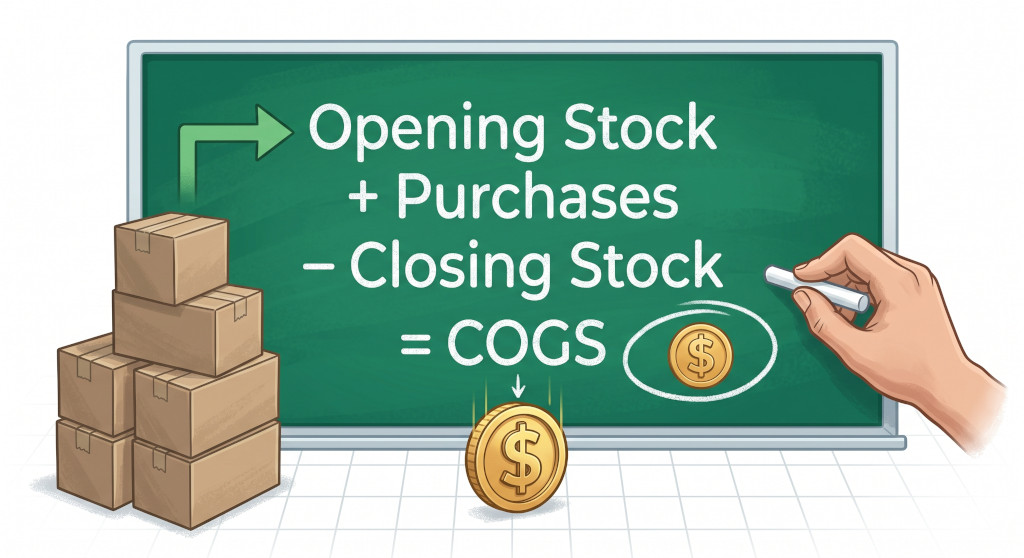
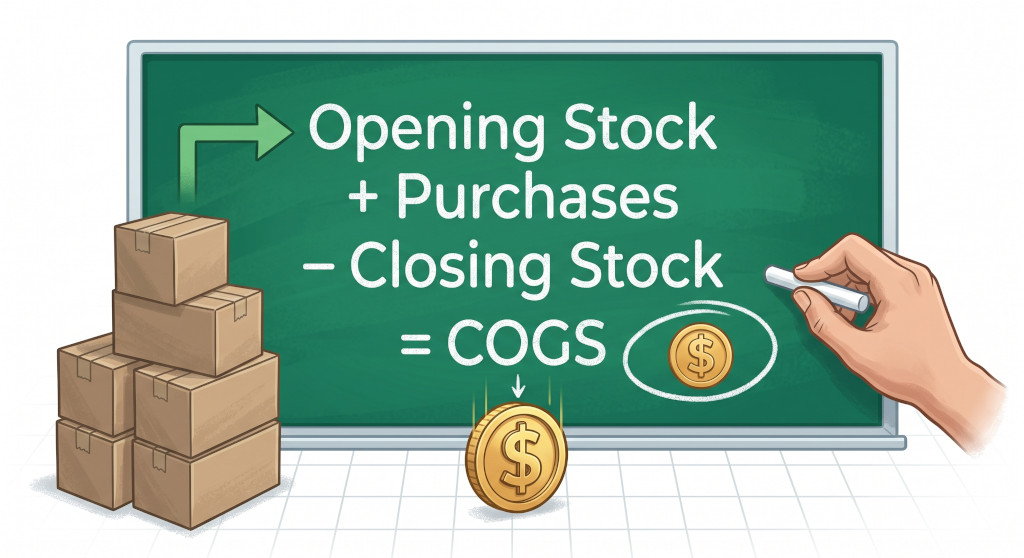
The standard COGS formula is:
COGS = Opening Stock + Purchases (or Production Costs) − Closing Stock
This formula captures the flow of inventory through the business during the period. You start with what you had, add what you acquired or made, and subtract what you still have at the end — leaving you with the cost of everything that was sold.
Worked Example
Imagine a small business that makes handmade wooden furniture. Here is their position for the month of July 2026:
| Item | Amount |
|---|---|
| Opening stock (finished goods + raw materials, 1 July) | £8,200 |
| Raw materials purchased during July | £14,500 |
| Direct labour (workshop staff wages, July) | £6,800 |
| Workshop utilities (electricity, machine maintenance) | £900 |
| Total goods available for sale | £30,400 |
| Less: Closing stock (unsold inventory, 31 July) | –£9,600 |
| COGS for July | £20,800 |
If the business generated £35,000 in revenue during July, their gross profit is £35,000 − £20,800 = £14,200, giving a gross margin of approximately 40.6%.
The closing stock figure (£9,600) carries forward to become the opening stock figure for August — which is how inventory and COGS link across accounting periods. An accurate stock count at month end is therefore not a tidying-up exercise; it is a prerequisite for getting COGS right.
Why COGS Matters for Your Business
COGS is not just an accounting line — it is one of the most powerful levers in your business. Understanding it clearly drives better decisions across pricing, procurement, and operations.
Gross margin analysis. Your gross margin (revenue minus COGS, expressed as a percentage) tells you how efficiently your core business model works before overhead is considered. A furniture maker with a 40% gross margin has 40p of every pound left to cover rent, salaries, marketing, and profit. If that margin drops to 30%, the entire business model may become unviable without a price increase or cost reduction. Tracking gross margin month by month is one of the most important habits any product business can build.
Pricing decisions. You cannot price your products correctly without knowing what they cost to make. COGS gives you your cost floor — the minimum price at which a sale is not loss-making. Many small business owners underprice their products because they underestimate COGS by forgetting to include direct labour, or by using average costs that do not reflect current material prices.
Supplier negotiations. A clear view of COGS makes supplier negotiations more purposeful. If raw materials represent 60% of your COGS, a 10% reduction in material costs has an immediate and quantifiable impact on gross margin — and you can model that impact precisely before you walk into the negotiation.
Tax accuracy. COGS is a deductible business expense that reduces your taxable profit. Over-stating COGS understates profit and underpays tax; understating it does the reverse. Either way, an inaccurate COGS creates tax risk and unreliable financial statements.
For a fuller picture of how COGS fits into the income statement — and how gross profit, operating profit, and net profit build on each other — the guide to understanding the income statement walks through each line in detail.
COGS for Service Businesses
Service businesses — consultancies, agencies, software companies, accountancy firms — do not hold physical inventory, so the concept of COGS applies differently. Many service businesses refer instead to Cost of Revenue or Direct Costs, which covers the expenses directly tied to delivering the service: the salaries of billable staff, subcontractor fees, software licences used directly in client delivery, and similar items.
The principle is the same: separate the costs that are directly and proportionally tied to delivering your service from the overhead costs of running the business. This gives you a gross margin for your service business that is directly comparable to a product business’s gross margin, and allows you to ask the same useful questions: are we pricing correctly, are delivery costs creeping up, can we improve margins by changing how we staff projects?
For service businesses, the challenge is often that the biggest direct cost — staff time — is shared between billable client work and internal activities. Time-tracking, even approximate time-tracking, is the most practical way to get an accurate picture of true cost of revenue.
Key Takeaways
- COGS (cost of goods sold) is the direct cost of producing or purchasing the goods your business sold during an accounting period — it appears on the income statement directly below revenue.
- The formula is: Opening Stock + Purchases/Production Costs − Closing Stock = COGS.
- Only direct costs belong in COGS: raw materials, direct labour, and manufacturing overhead. Indirect costs like marketing, administration, and management salaries are operating expenses.
- Revenue minus COGS equals gross profit; gross profit divided by revenue gives you your gross margin — one of the most important indicators of business health.
- An accurate stock count at period end is essential for calculating COGS correctly; inventory valuation method (FIFO, AVCO, etc.) directly affects the COGS figure.
- For service businesses, the equivalent concept is Cost of Revenue or Direct Costs — the expenses directly tied to delivering the service.
- Getting COGS right is foundational for pricing decisions, supplier negotiations, tax accuracy, and reliable financial reporting.
Related Reading
- Understanding the Income Statement: A Complete Guide to Profit & Loss for SMEs
- Inventory Valuation Methods Explained: FIFO, LIFO, and AVCO for SMEs
- Gross, Operating, and Net Profit Margin: What They Mean and Why They Matter
- Key Financial Ratios Explained: A Complete Guide to Liquidity, Profitability and Efficiency